Search This Blog

Monday, 4 January 2016

Tibet's spiritual leader speaks on love, compassion, tolerance, forgiveness


Sunday, 03 January 2016 22:44 Jane Cook, Tibet Post International

Tibet-India-2015-808
His Holiness the Dalai Lama at the Tashi Lhunpo in Bylakuppe , Karnataka, India on December 22,2015 .
Photo : TPI/Yeshe Choesang
         
Bengaluru — In reply to a question about whether it is possible to preserve religious values without religion, the spiritual leader of Tibet suggested that in a world of 7 billion people, where 1 billion express no interest in religion, there has to be a way of exchanging the understanding of love, compassion, tolerance and forgiveness.

His Holiness addressed a meeting of the Indian Administrative Service (IAS) Association (Karnataka) in Bengaluru, Karnataka, India on January 2, 2016.. "Brothers and sisters," he greeted them. "I'm very happy to be able to meet with you today. "

"We are all part of humanity, 7 billion of us who are fundamentally the same. Of course, there are differences among us of faith, colour of skin and colour of hair, some of us come from different countries and speak different languages, but these are secondary differences." His Holiness said.

"The primary thing is that we are essentially the same. Many of the problems we face, we make for ourselves, based on our mistaken emphasis on these secondary differences between us," he said, adding: "Seeing each other in terms of 'us' and 'them' and being motivated by a strong sense of self-centredness are the source of violence, killing and corruption in our world."

"Instead we have to make an effort to promote a sense of the oneness of all human beings. We have to think about the welfare of the whole of humanity. If humanity is happy, as individuals we'll all be happy. If humanity is wracked with fear and suspicion, we'll be unhappy."

Comparing ancient Egyptian, Chinese and Indian civilizations, His Holiness suggested that the Indus Valley culture had given rise to by far the greatest number of thinkers and teachers, such as the Buddha. He said that as members of the IAS, his listeners were in a position to help promote and preserve ancient Indian values. He said he didn't mean performing pujas and rituals so much as values like ahimsa and the science of the mind.

"Knowledge of the mind, emotions and their workings is something that can be studied on an academic level. It's on that basis that I have engaged in discussions with modern scientists over the last 30 years. The benefits have been mutual. I've learned, for example, that traditional Buddhist cosmology, depicting a flat earth with Mt Meru at its centre, is mistaken.

"On the other hand, the quantum physics assertion that nothing has objective existence seems to correspond with the Madhyamaka view that, since all things depend on causes and conditions, they only exist as designations."

His Holiness told his audience that having lived the last 56 years, the best part of his life, in this country, thoroughly educated by ancient Indian thought, he feels like a son of India. Wherever he travels in the world he shares the ancient Indian ideas of ahimsa and inter-religious harmony.

"Be honest, transparent and truthful; that way you'll establish trust," His Holiness said when asked for his advice to Indian civil servants.

To a question about whether it is possible to preserve religious values without religion he said this is what he calls secular ethics. He conceded that some friends are wary of the word secular, but he interprets it to mean respect for all religious traditions and even the views of those who have no faith. He suggested that in a world of 7 billion people, where 1 billion express no interest in religion, there has to be a way of exchanging the understanding of love, compassion, tolerance and forgiveness.

That way is to cultivate secular ethics. His Holiness mentioned ongoing projects in North America, Europe and India to formulate a curriculum to incorporate secular ethics into the modern education system. He also noted the effectiveness of nearly a dozen US cities declaring themselves 'cities of kindness'.

A final questioner wanted to what had happened when the Buddha achieved enlightenment under the Bodhi Tree. First His Holiness drew attention to the more than 300 volumes of scripture translated from Sanskrit into Tibetan that can be seen as answering this. Then he mentioned Buddha nature that refers to the fundamental mind, a mind that is naturally pure, that is free from anger, attachment and ignorance. Since these defilements or disturbing emotions are not a part of that mind, they can be eliminated. When that occurs, the Buddha's mind is revealed.

Wednesday, 30 December 2015

Rakhigarhi: Indian town could unlock mystery of Indus civilisation

Some news on the aDNA which will probably decide the Indo-European History of India.

Rakhigarhi: Indian town could unlock mystery of Indus civilisation

Archaeologists hope DNA from four skeletons will shed light on bronze age settlement as locals see chance to develop more than just site’s ancient heritage

Jason Burke  in Rakhigarhi
Wednesday 30 December 2015 11.29 GMT


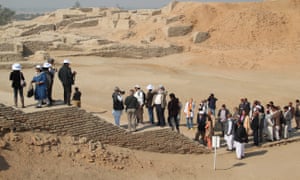
Visitors at the archeological site of Mohenjo-daro in Sindh province, Pakistan
 Visitors at the archeological site of Mohenjo-daro in Sindh province, Pakistan, one of the main centres of the Indus civilisation. Photograph: Waqar Hussain/EPA

 Wazir Chand is explaining life 4,000 years ago. He points to the rocky mounds looming over a huddle of brick houses, a herd of black buffalo and a few stunted trees. The rising sun burns off a chill mist over the north-west Indian plains.

A low rise was a fortification, Chand says, and a darker patch of red earth hides the site of an altar. Nimbly stepping around piles of buffalo dung, he points to a slight depression. This, apparently, was a pit that may have been a reservoir.

To the casual onlooker, Rakhigarhi is unimpressive. Yet the rubbish-strewn mounds and fields around and under this Indian village are set to deliver the answer to one of the deepest secrets of ancient times.

Rakhigarhi is a key site in the Indus Valley civilisation, which ruled a more than 1m sq km swath of the Asian subcontinent during the bronze age and was as advanced and powerful as its better known contemporary counterparts in Egypt and Mesopotamia.

Archaeologists have learned much about the civilisation since it was discovered along the Indus river in present day Pakistan about a century ago. Excavations have since uncovered huge carefully designed cities with massive grain stores, metal workshops, public baths, dockyards and household plumbing, as well as stunning distinctive seals. But many perplexing questions remain unanswered.

One has stood out: who exactly were the people of the Indus civilisation? A response may come within weeks.

“Our research will most definitely provide an answer. This will be a major breakthrough. I am very excited,” said Vasant Shinde, an Indian archaeologist leading current excavations at Rakhigarhi, which was discovered in 1965.

Shinde’s conclusions will be published in the new year. They are based on DNA sequences derived from four skeletons – of two men, a woman and a child – excavated eight months ago and checked against DNA data from tens of thousands of people from all across the subcontinent, central Asia and Iran.
“The DNA is likely to be incredibly interesting and it has the potential to address all sorts of challenging questions about the population history of the people of the Indus civilisation,” said Dr Cameron Petrie, an expert in south Asian and Iranian archaeology at the University of Cambridge.

The origins of the people of the Indus Valley civilisation has prompted a long-running argument that has lasted for more than five decades.

Some scholars have suggested that they were originally migrants from upland plateaux to the west. Others have maintained the civilisation was made up of indigenous local groups, while some have said it was a mixture of both, and part of a network of different communities in the region. Experts have also debated whether the civilisation succumbed to a traumatic invasion by so-called “Aryans” whose chariots they were unable to resist, or in fact peaceably assimilated a series of waves of migration over many decades or centuries.

The new data will provide definitive answers, at least for the population of Rakhigarhi.

“There is already evidence of intermarriage and mixing through trade and so forth for a long time and the DNA will tell us for sure,” Shinde said.

The conclusions from the new research on the skeletal DNA sample – though focused on the bronze age – are likely to be controversial in a region riven by religious, ethnic and nationalist tensions.

Hostile neighbours India and Pakistan have fought three wars since winning their independence from the British in 1947, and have long squabbled over the true centre of the Indus civilisation, which straddles the border between the countries.

Shinde said Rakhigarhi was a bigger city than either Mohenjo-daro or Harrapa, two sites in Pakistan previously considered the centre of the Indus civilisation.

Some in India will also be keen to claim any new research supports their belief that the Rig Veda, an ancient text sacred to Hindus compiled shortly after the demise of the Indus Valley civilisation, is reliable as an historical record.

The question of links between today’s inhabitants of the area and those who lived, farmed, and died here millennia ago has also prompted fierce argument.

There are other mysteries too. The Indus Valley civilisation flourished for three thousand years before disappearing suddenly around 1500 BC. Theories range from the drying up of local rivers to an epidemic. Recently, research has focused on climate change undermining the irrigation-based agriculture on which an advanced urban society was ultimately dependent.

Soil samples around the skeletons from which samples were sent for DNA analysis have also been despatched. Traces of parasites may tell archaeologists what the people of the Indus Valley civilisation ate. Three-dimensional modelling technology will also allow a reconstruction of the physical appearance of the dead.

“For the first time we will see the face of these people,” Shinde said.

In Rakhigarhi village, there are mixed emotions about the forthcoming revelations about the site.

Chand, the self-appointed guide and amateur expert, hopes the local government will finally fulfil longstanding promises to build a museum, an auditorium and hotel for tourists there.

“This is a neglected site and now that will change. This place should be as popular as the Taj Mahal. There should be hundreds, thousands of visitors coming,” Chand told the Guardian.

A brief glance at the rubbish strewn middens which the mounds of the ancient city have become, indicates the work to be done before Rakhigarhi becomes a major attraction. The inhabitants of today’s Rakhigarhi lack many of the facilities enjoyed by those who lived there in the bronze age. Raj Bhi Malik, the village head, sees an opportunity to develop more than the site’s ancient heritage.

“We want a museum and all that certainly … but also clean drinking water, proper sanitation, an animal hospital, a clinic too,” Malik said.
 Yog.
UPDATE :
Here is a recent post from a well known genome blogger. This only again reflect, the importance of the study, regarding the Indo-European question.

Update II : Here another post on the monumental study.
 .

Saturday, 7 November 2015

INDOLOGICA TAURINENSIA


A very good website for people looking for  high quality researches.

Sunday, 28 June 2015

Human Skeletal Remains from Ancient Burial Sites in India: With Special Reference to Harappan Civilization


Astha Dibyopama,1 Yong Jun Kim,1 Chang Seok Oh,2 Dong Hoon Shin,2 and Vasant Shinde1
1Department of Archaeology, Deccan College Post Graduate and Research Institute, India.
2Department of Anatomy, Institute of Forensic Science, Seoul National University, Korea. Correspondence to: Vasant Shinde. (Deccan College, Post-Graduate & Research Institute (Deemed University)
Abstract

Harappan Civilization is well known for highly sophisticated urban society, having been flourished in extensive regions of northwestern part of Pakistan and northeastern part of Afghanistan as its heyday around 4500 years ago. Most archaeologists agree on the periodization of this civilization as three different phases (Early, Mature and Late), which represent its cultural process of origin, development and decline. From the Harappan sites, one can note that there were about more than fifty burial sites discovered so far related with the civilization. In this article, we are trying to introduce the brief picture of the Harappan burials from the archaeological as well as anthropological perspectives.
Debates on Harappan People
From the perspective of anthropology, nothing is more important than studies on who were the inhabitants of Harappan civilization. Therefore, concerning biological affinities of the Indus valley inhabitants during Harappan period , we must note that there have been very hot debates among the related archaeologists and anthropologists. By anthropological researches over skeletal remains, some researchers claimed that two to four races might have been co-present in Harappan society. Any variation from these idealized types of races was explained as the result of admixture between pure races.  
However, we could not make an easy conclusion on this hypothesis because researchers like Brian Hemphil and J. R. Lukacs thought differently. By research on cranial features of the skeletons from Harappan burial sites, they tried to assess the biological continuity or discontinuity among the peoples in regions. About the subject, they can give following speculation: early chalcolithic inhabitants of Mehrgarh and late Harappan inhabitants of Cemetery H in Harappa share close biological affinity. In fact, they could not deny the long period of in situ continuity of Harappan peoples' biological traits .
Although we agree the viewpoint of Hemphil and Lukacs in general, it could not be easily denied that the biological continuity also coupled with the occasional pulses of genetic input from outside either. We speculate that the genetic input might have been conditioned by frequent trade of India, which could be further cemented by marriage alliances between the peoples in different areas. The first genetic exchange must have occurred from Neolithic period, between the Indus valley and the Iranian Plateau. During the 1st millennium B.C., the secondary genetic exchange based on seaborne trade could be identified. The trade routes appear to have shifted to a gradual introduction of new genes into the Indus valley and then neighboring lands . In fact, the origin and continuity of ancient Indian people has been the one of the main subjects anthropologists worldwide have discussed about; and it will remain as such, for the time being in the future.
 Burials in different Harappan sites. (A) and (B) Burials at Mehrgarh site. (A) Burial in clay box (B) Mehrgarh burials, pit with side chamber closed up with mud bricks. (C) and (D) Burials found at Kalibangan site. (C) Pot Burial without Skeleton. (D) Kalibangan brick-lined grave. (E) A burial at Lothal site. A double burial inside brick lined grave.
Conclusion

In this article, we attempted to project brief picture of burial tradition followed by the health and diet of the people of Harappan civilization. In fact, excavated Harappan burials are scanty in India and not much in-depth scientific research has been carried out on them, comparing with the Harappan habitation site. But still the data available to us till date about the Harappan burial practices is quite helpful in reconstructing the different aspects of Harappan population, their life style, socio economic status etc.
We note that the evidence of human remains and burials of Harappan civilization provided substantial amount of information about the society. And forthcoming studies on human remains from Harappan sites will provide invaluable information on the health and disease status of the people from one of the oldest ancient civilizations around the world. In fact, considering that archaeological and anthropological information was always significant to each other, for getting the comprehensive knowledge about the ancient Harappan society, interdisciplinary collaboration between two research fields would be still necessary in the future.
Yog.


Tuesday, 26 May 2015

Ancient Iron Works From South India

I came to know about the discovery from this website ,it also reminds me the case of  Hallur Horse.

Rare discovery pushes back Iron Age in India

Siddharth Tadepalli 

HYDERABAD: Iron Age may have come into existence in Telangana much before the rest of the world. At least that's the conclusion reached by archaeologists excavating the University of Hyderabad campus who found iron artefacts dating back to roughly 2,200 BCE.

The team of archaeologists, led by professor KP Rao, has found several artefacts, including small knives and blades besides earthen pots. "The implements that were found were tested at the National Geophysical Research Institute (NGRI) using a method called Optically Simulated Luminescence (OSL). The metal objects were dated to anywhere between 1800 BC and 2,400 BCE. So we are assuming they were made during 2200 BC," Prof KP Rao told TOI.

This, he said, predates the existing understanding about the advent of the Iron Age in the country. Worldwide, experts have put the dawn of the age around 1200 BC, marking the time when humans started exploiting metals to make basic tools.

"In India, it was understood that the Iron Age came into being around 1,800 BC in the Lahuradeva site in Uttar Pradesh. But this latest development shows that the Iron Age started much before that, at least in our country," Rao said.

"It only goes to show that our ancestors had a rudimentary yet good knowledge about wielding weapons made of metals. We had estimated that the only metal that was moulded was copper, but due to its scarce nature it was not a feasible option. The idea of using abundant iron ore for tools and weapons is a landmark achievement," he added.

The idea of using iron has only come to lead to more and more developments. "It is because of their advancements did we reach the space-age," he said.

Currently, archaeologists have excavated 25 burial sites in the UOH area and the samples have been subjected to DNA analysis.
Yog.
Related News-

Sunday, 3 May 2015


Evidence for Patterns of Selective Urban Migration in the Greater Indus Valley (2600-1900 BC): A Lead and Strontium Isotope Mortuary Analysis


  •  Benjamin Valentine,George D. Kamenov,,
  • Jonathan Mark Kenoyer,,
  • Vasant Shinde,
  • ,Veena Mushrif-Tripathy,
  •  Erik Otarola-Castillo,
  • ,John Krigbaum

Abstract


Just as modern nation-states struggle to manage the cultural and economic impacts of migration, ancient civilizations dealt with similar external pressures and set policies to regulate people’s movements. In one of the earliest urban societies, the Indus Civilization, mechanisms linking city populations to hinterland groups remain enigmatic in the absence of written documents. However, isotopic data from human tooth enamel associated with Harappa Phase (2600-1900 BC) cemetery burials at Harappa (Pakistan) and Farmana (India) provide individual biogeochemical life histories of migration. Strontium and lead isotope ratios allow us to reinterpret the Indus tradition of cemetery inhumation as part of a specific and highly regulated institution of migration. Intra-individual isotopic shifts are consistent with immigration from resource-rich hinterlands during childhood. Furthermore, mortuary populations formed over hundreds of years and composed almost entirely of first-generation immigrants suggest that inhumation was the final step in a process linking certain urban Indus communities to diverse hinterland groups. Additional multi disciplinary analyses are warranted to confirm inferred patterns of Indus mobility, but the available isotopic data suggest that efforts to classify and regulate human movement in the ancient Indus region likely helped structure socioeconomic integration across an ethnically diverse landscape.
Fig 1.  Map of the Indus Civilization culture area with locations mentioned in the text.

From The Conclusion-
A consideration of the isotopic data and their bioarchaeological context allows certain inferences to be made about the proposed Indus institution. Isotopic [12] and osteological [13] distinctions between males and females at Harappa and the timing of migration at Farmana suggest certain hinterland individuals from distinct genetic populations took up residence with new corporate groups at a very young age. The inclusion of modest burial wealth may indicate they were treated with respect by local groups, whereas sex-based distinctions in provenience suggest migrants were selected according to the preferences of their natal groups rather than the whims of Indus urbanites. Thus the Indus institution of immigration was integrative, accommodating various ethnic or cultural groups within a standardized set of practices reserved exclusively for a class of first generation immigrant. Furthermore, the scarcity of cemetery inhumations and their potential association with resource-rich regions suggests the institution may have been limited in scope to the economic interests of specific mercantile groups rather than all segments of society. Ethnography from the nearby Hindu Kush Range suggests one possible analogy for the Indus institution. Asymmetric systems of fosterage employed by fractious historical kingdoms to build hierarchical political alliances [86] may be broadly comparable to Indus practices, such that fostered individuals literally embodied the relationships between urban and hinterland groups. Whether or not this particular model is borne out by additional multi-disciplinary analyses, however, our isotopic inferences of migration define key parameters in any future investigation of Indus Civilization inter regional interaction. 

Monday, 16 March 2015

Nurture my tongue: A linguist’s quest to preserve an endangered language

Written by Amruta Lakhe | Published on:October 19, 2014 1:00 am

Jalgaon Jamod is a sleepy tehsil tucked away in the Satpura ranges of the Buldhana district on the Maharashtra-Madhya Pradesh border. While Jalgaon means water village, the name Jamod possibly dates back to the 17th century. Mughal empress Mumtaz Mahal, while travelling to Burhanpur, Madhya Pradesh, with Emperor Shah Jahan, died during childbirth near Jamod, giving rise to the name, “Ja-e-Maut” or “place of death”. Over the last few decades, Jalgoan Jamod finds itself witness to a slow death: of its rich and ancient language, Nihali. Spoken by the locals for centuries, the language now has only 2,500-odd speakers and has recently found itself in Unesco’s list of critically endangered languages.
The urgency of this vanishing language was not lost on Dr Shailendra Mohan, associate professor in Austro-Asiatic linguistics at Pune’s Deccan College Postgraduate and Research Institute. Five years ago, the linguist began his search for the language’s origins, digging at its roots by treading the dusty paths of Jalgaon Jamod.
Even for an endangered language, Nihali is special. “Nihali is a language isolate. This means that it is not related to any other family of languages,” says Mohan. Like, he explains, hand in Marathi is haath and in Punjabi is hatha. “These regions are miles away from each other, yet their lexicon is derived from one family of language: Indo Aryan. But Nihali does not belong to any of the four Indian language families.” One theory is that it is the relic of some ancient pre-Indo Aryan, pre-Dravidian, pre-Tibeto-Burman and pre-Austroasiatic lost language, with possible links to other language groups such as Nostratic, Kusunda, a language spoken in Nepal, and with Ainu in Japan. “But we still don’t know for sure where it originated, which makes it extremely rare and precious.”
Shailendra Mohan interacts with a villager in Jalgaon.
Mohan had been studying the language for years ever since it became a part of his research while studying at Jawaharlal Nehru University (JNU), Delhi. He was awarded a grant from the Endangered Languages Project by the School of Oriental and African Studies, London, last year to begin the first documentation of Nihali. “There is no government support in Jalgaon Jamod, nor is there an academic body that supports this kind of study. So establishing trust and building contact with the locals was crucial,” he says. Over repeated trips, Mohan visited schools, town offices, attended the panchayat meetings and asked for help from the sarpanch. Two years later, when he was confident that he had built a good rapport with the locals, he began work.
He would listen to village elders render folk stories and songs in broken Nihali and soon came to realise how rich their history and mythology was. “For instance, Nihalis sing songs of the Ramayana, but they also worship Ravana as their hero,” he says. As the locals spoke, Mohan took photographs, shot hours of video footage and wrote extensive notes which he would translate word for word later. Nihali has a unique sound pattern: water is joppo, to eat is ti and drink is delen. Surrounded by forests, the locals have their own version of Panchatantra or fables with animals at its centre.
When the locals became aware of Mohan’s quest, they appreciated someone recording their songs, stories and their lifestyle. “Language changes unconsciously, we do not realise it during every day use. But the documentation programme has inculcated a sensitivity towards their language. They are now aware that their language is different from other communities and that there are less number of speakers,” he says.
Though Mohan’s project is just about documenting the language, he is also looking at why Nihali is nearing extinction. “The locals have inter-married the language with Marathi, Korku and Hindi. Even if a child speaks Nihali at home, once he enters a classroom, he instantly switches to Marathi. A language stays alive only when parents speak the mother tongue with their children. I don’t see that happening with Nihali. When the next two generations pass by, the language might vanish with them,” he says. That there is no defined script for Nihali adds to the problem.
In the final phase of his project, Mohan is collating more than 20 hours of archival video, audio recordings and thousands of photographs of the locals to come up with a basic text on Nihali grammar. He will soon publish the first trilingual dictionary of Nihali-English-Hindi with 2,000 words. While Mohan’s search continues, Nihali’s struggle for survival has just begun.