Search This Blog

Showing posts with label Indology. Show all posts

Saturday, 26 May 2018

FORESTS IN THE OLDEST CYCLES OF RIGVEDA

Another solid article from Dr. Semenenko

Семененко А.А.
Gymnasia No 2, Voronezh, Russia
FORESTS IN THE OLDEST CYCLES OF RIGVEDA.
Abstract. The article deals with the description of forests and trees in the most archaic parts of Rigveda (Mandalas II-VII and IX). The author demonstrates that the Rigvedic Indo-Aryans lived in immediate proximity of the forests, visited them regularly, used them as source of wood and food, gave names to at least five of the endemic trees of Hindustan, divinized and worshipped trees and considered them aspects of the Divine Mother and Devas.
Key words: Rigveda, Indo-Aryans, forests, trees, Ashvattha, Harappa.

 The translator of Rigveda [1] (further RV) into Russian T.Ya. Elizarenkova is an adherent of the Aryan Invasion/Immigration Theory and as such she states that Rigvedic Indo-Aryans (further IA) entering Hindustan were mostly nomads previously living in the vast open spaces of the Eurasian steppe. Speaking of the forests’ role in life of RV authors she writes: “Aryans of RV knew of the forests but they had not yet made use of them. The term vána- seldom means ‘forest’ in this text. Forest was thought of as something remote and unfamiliar. It was contraposed to home/a house (amā́, dáme) and to a village (grā́me)... This opposition is a variant of a more generic one: ‘own’ - ‘alien’ or ‘inner’ - ‘outer’. When the term vána- is used in RV in the sense of the ‘forest’ in most cases it means a place which scares and which is attacked by the Aryan gods (Agni, Indra, Maruts). Unlike water and mountains forests in RV were not associated with the gods… Long time passed before Aryans gradually made use of the forests… It happened in the period following great Vedic collections - Samhitas… Forests are poorly represented in RV… Both rivers and mountains were divinized and reflected in mythology. There was no place for forest in it. RV preserves the names of sacred and profane trees of different species (sometimes they are of local origin)” [2].
Let us see what the most archaic cycles of RV (Mandalas II-VII and IX) tell us about the forests. As far as is known forest is made up of trees. And trees are abundantly and with the use of different words mentioned in the most ancient parts of RV: big trees (vánaspátīn) - 19 times (II.3.10; III.4.10; III.8.1, 3, 6, 11; III.34.10; V.7.4; V.5.10; V.41.8; V.42.16; V.78.5; V.84.3; VI.15.2; VI.48.17; VII.2.10; VII.34.23; IX.5.10; IX.12.7), ordinary trees - 43 times (II.1.1; II.4.5, 6; II.14.2; II.31.1; II.39.1; III.23.1; III.45.4; IV.20.5; V.1.5; V.11.6; V.41.10, 11; V.54.6; V.57.3; V.58.6; V.60.2; V.78.6; V.83.2; V.85.2; VI.2.9; VI.3.5; VI.6.3; VI.8.5; VI.13.1; VI.18.10; VI.24.3; VI.33.3; VI.39.5; VI.48.5; VI.57.5; VI.60.10; VII.4.2, 5; VII.7.2; VII.34.25; VII.35.5; VII.43.1; VII.56.25; VII.95.5; IX.72.5; IX.96.6; IX.97.53), forests (following the very translation of T.Ya. Elizarenkova) - 13 times (II.38.7; III.6.7; III.34.3; III.51.5; IV.7.1, 6; V.41.11; V.78.8; VI.12.3; VI.31.2; VII.1.19; IX.33.1; IX.92.6). It is evident that numerous trees were integral and very well known element of Rigvedic landscape already during the earliest period of Mantras’ composition. Forests around the poets of RV were so large that they were afraid to get lost in them (mā́ no vána ā́ juhūrthāḥ) (VII.1.19).
T.Ya. Elizarenkova’s statements about the poor forests’ representation in RVedic religion and mythology also disagree with RV information. We learn that Indra seized big trees (índra vánaspátīm̐r asanod) (III.34.10) and is identified as an ordinary tree (vr̥kṣásya nú te puruhūta vayā́ ví ūtáyo ruruhur indra pūrvī́ḥ) (VI.24.3), that Soma is the lord of the trees or a big tree himself (vánaspátir) (IX.12.7), that Agni’s boons come out of him as branches out of an ordinary tree (tuvád víśvā saúbhagāni ágne ví yanti vaníno ná vayā́ḥ) (VI.13.1). It was under the big trees where Rigvedic Aryans sacrificed (II.3.10; III.4.10; V.5.10; VII.2.10; IX.5.10). Big trees were used to produce and erect sacrificial posts identified with them (III.8.1-4, 6-11).
It is contrary to T.Ya. Elizarenkova’s words that only big trees were considered sacred [3] that Indra is called an ordinary tree (vr̥kṣásya), that Agni is compared to an ordinary tree (vaníno), that Ashvins are described as commanding not only big but also an ordinary tree: ví jihīṣva vanaspate yóniḥ sū́ṣyantiyā iva | śrutám me aśvinā hávaṃ saptávadhriṃ ca muñcatam || bhītā́ya nā́dhamānāya ŕ̥ṣaye saptávadhraye | māyā́bhir aśvinā yuváṃ vr̥kṣáṃ sáṃ ca ví cācathaḥ ‘O tree (vanaspate), spread apart, like the womb (yóniḥ) of a woman about to give birth (sū́ṣyantiyā). Hear my call, Aśvins, and free Saptavadhri. || For the seer Saptavadhri, who is fearful and in need, o Aśvins, you bend the tree (vr̥kṣáṃ) together and apart by your cunning’ (V.78.5-6) [4]. Also we see in the last verses the identification of a tree with a woman-giving-birth [5] which means that for the Rigvedic IA tree was an aspect of the Divine Mother.
T.Ya. Elizarenkova’s words that only big trees were considered sacred disagree with the fact that RV contains stereotyped prayers to big (vánaspátīm̐r, vánaspátibhiḥ) and ordinary (vaníno) trees (námobhir vánaspátīm̐r óṣadhī rāyá éṣe (V.41.8), praíṣá stómaḥ vánaspátīm̐r óṣadhī rāyé aśyāḥ (V.42.16), tán no rā́yaḥ óṣadhīr utá vánaspátibhiḥ || rāyáḥ siyāma dharúṇaṃ dhiyádhyai || tán na óṣadhīr vaníno juṣanta (VII.34.23-25), śáṃ na óṣadhīr vaníno bhavantu (VII.35.5)). It seems indeed very strange for the people unfamiliar with forests not only to compose such prayers but also to ask ordinary trees for blessings while moving into a new locality (apó yéna sukṣitáye tárema ádha svám óko abhí vaḥ siyāma || tán na óṣadhīr vaníno juṣanta) (VII.56.24-25).
All these facts point to an active use of forests already in the period of composing of the earliest hymns of RV which is further proved by mentions of timber cutting (VI.8.5; IX.96.6) and fruit gathering (III.45.4; IX.97.53) in the forests and burning wood in the process of metal smelting (dravír ná drāvayati dā́ru dhákṣat) (VI.3.4).
Trying to give us evidence of the Rigvedic IA’s poor knowledge of the forests T.Ya. Elizarenkova informs us that ‘RV preserves the names of sacred and profane trees of different species (sometimes they are of local origin)’. But what she ‘forgets’ to make clear is that the endemic trees of the South Asia (khadirá (Acacia Catechu), spandaná (Diospyros embryopteris) and śiṃśápā (Dalbergia Sissoo)) are enumerated as a source of wood to produce the wheeled vehicles only in one of the Family Cycles (Mandalas II-VII) of the Samhita (III.53.19) and nowhere else in it and that RV knows not of any of the out-of-India tree species... The very same hymn mentions the cutting down of one more local tree Bombax heptaphyllum L. or Salmalia malabarica named śimbalá or śalmalí (paraśúṃ cid ví tapati śimbaláṃ cid ví vr̥ścati) (III.53.22) [6]. Poison of Salmalia malabarica is also mentioned in the other Family Mandala of RV (yác chalmalaú bhávati viṣám) (VII.50.3). A die made of an oval nut of the large tree Terminalia bellerica (vibhī́dako) is described in the same Mandala (VII.86.6) [7]. And again next Family Cycle speaks of the big tree Kakambira (mā́ kākambī́ram úd vr̥ho vánaspátim) (VI.48.17). Although it is not identified [8] its name is evidently local.
Maruts are described as flipping off the sky a berry (nā́kam rúśat píppalam maruto ví dhūnutha) (V.54.12) but whether this berry (píppalam) belongs to the famous South Asian tree aśvatthá (Ficus religiosa or Ficus peepul) can’t be said with certainty. J. McIntosh writes of the cult of this tree in the North-Western Hindustan during the Mature Harappan epoch (2600-1900 BCE): ‘A number of tablets show an individual with a pot, apparently making an offering to a tree, usually a pipal. A few seals show figures that may be identified as gods and goddesses inside these trees, particularly the pipal, or under an arch of pipal leaves. These leaves had been a familiar decoration on pottery of the northwest since much earlier times; they were often combined with the horns of bulls or water buffaloes, and together they form headdresses worn by a number of deities’ [9]. But this tree is surely spoken of in the most modern cycles of RV: átrā́ha tád vahethe mádhva ā́hutiṃ yám aśvatthám upatíṣṭhanta jāyávo (I.135.8), vr̥kṣám pári ṣasvajāte | táyor anyáḥ píppalaṃ svādú átti (I.164.20), vr̥kṣé tásyéd āhuḥ píppalaṃ svādú ágre (I.164.22), óṣadhīr mātaras devīr || aśvatthé vo niṣádanam parṇé vo vasatíṣ kr̥tā́ (X.97.4-5) [10].
So we see that the earliest part of RV enumerates five (or may be six) endemic trees of the South Asia - khadirá (Acacia Catechu) (III.53.19), spandaná (Diospyros embryopteris) (III.53.19), śiṃśápā (Dalbergia Sissoo) (III.53.19), śimbalá or śalmalí (Bombax heptaphyllum или Salmalia malabarica) (III.53.22; VII.50.3),vibhī́daka (Terminalia bellerica) (VII.86.6) and aśvatthá (Ficus religiosa) (V.54.12) (a case in dispute).
It should be noted especially that the authors of the Mandalas II-VII and IX know not of Ficus religiosa, the cult of which was widely spread in their habitat in III Millennium BCE. This makes us date the core of RV several centuries prior to 2600 BCE at least for IA while entering Hindustan in the III or II Millennium BCE should have learnt of that most venerable local tree at once and mention its name already in the most archaic cycles of RV. That IA learnt at once the names of the endemic trees of the South Asia is proved by the fact of inserting the names of local trees - khadirá (Acacia Catechu), spandaná (Diospyros embryopteris), śiṃśápā (Dalbergia Sissoo), śimbalá or śalmalí (Bombax heptaphyllum or Salmalia malabarica), vibhī́daka (Terminalia bellerica) - already in the Family Mandalas of the Samhita. The fact that IA mentioned the name of Ficus religiosa only in the first and the tenth Mandalas makes it clear that Mandalas II-IX were composed several centuries before 2600 BCE, while Mandalas I and X were added about 2600 BCE and reflected the widespread cult of this tree in Early Harappan and Mature Harappan culture of Hindustan of the III Millennium BCE.
So we see that already in the period of composing of the most archaic parts of RV (cycles II-VII and IX) IA lived in immediate proximity of the forests, visited them regularly, used them as source of wood and food, gave names to at least five of the endemic trees of Hindustan, divinized and worshipped trees and considered them aspects of the Divine Mother and Devas. This disproves the Aryan Invasion/Immigration Theory and supports the autochthonous origin of the Rigvedic IA in the North-Western South Asia. 
Список литературы
1. Ригведа. Изд. подг. Т.Я. Елизаренкова. В 3 тт. - М.: Наука, 1989-1999; Rigveda. Metrically Restored Text. Eds. K. Thomson & J. Slocum // [Электронный ресурс:] http://www.utexas.edu/ cola/centers/lrc/RV/.
2. Елизаренкова Т.Я. Слова и вещи в Ригведе. - М.: Наука. Издательская фирма «Восточная литература» РАН, 1999. - С. 109-110.
3. Ibid. - С. 109.
4. The Rigveda. The earliest religious poetry of India. Tr. by S.W. Jamison & J.P. Brereton. - Oxford-NY: Oxford University Press, 2014. - P. 761.
5. Елизаренкова Т.Я. Примечания // Ригведа. Мандалы I-IV. Изд. подг. Т.Я. Елизаренкова. - М.: Наука, 1989. - С. 714; Przyluski J. Non-Aryan Loans in Indo-Aryan // Lévi S., Przyluski J., Bloch J. Pre-Aryan and Pre-Dravidian in India. Tr. from French by P.Ch. Bagchi. - New Delhi-Madras: Asian Educational Services, 2001. - P. 6-8.
6. Macdonell A.A., Keith A.B. Vedic Index of Names and Subjects. Vol. II. - L.: John Murray, 1912. - P. 303; Елизаренкова Т.Я. Примечания // Ригведа. Мандалы IX-X. Изд. подг. Т.Я. Елизаренкова. - М.: Наука, 1999. - С. 442.
7. Елизаренкова Т.Я. Примечания // Ригведа. Мандалы V-VIII. Изд. подг. Т.Я. Елизаренкова. - М.: Наука, 1999. - С. 598.
8. McIntosh J. The ancient Indus valley: new perspectives. - Santa Barbara: ABC-CLIO, 2008. - P. 284-285.
9. Macdonell A.A., Keith A.B. Vedic Index of Names and Subjects. Vol. I. - L.: John Murray, 1912. - P. 43-44.
 Yog (Page 331).

Wednesday, 7 March 2018

Painted Grey Ware Culture: Changing Perspectives

With important updates . 

Painted Grey Ware Culture: Changing Perspectives
Vinay Kumar Gupta1 and B.R.Mani 2
Abstract:Painted Grey Ware culture is  one of the significant archeological cultures of northern India.It  has been a subject of attraction and debate among scholars. The most crucial aspect about this culture has been its chronology and its proposed relation to the  Mahabharata.The issue of its authorship is equally important.This article discusses all these issues afresh in the light of the new radiocarbon dates obtained from various sites and the first author’s detailed archaeological survey in the Mathura region, a core area  of Painted Grey Ware culture. This article voices for a change  in  the  accepted  chronology of this culture   and   takes   back   its antiquity by  many centuries. A proposition is also made about the place of origin of this culture which differs from the earlier propositions.
Keywords: PGW,OCP, BSW,NBPW,Grey Ware,Mahabharata,Radiocarbon Date

Yog

See also :
Implications of a Recent Hoard of Copper Objects from Harinagar,District Bijnor,Uttar Pradesh

Sunday, 25 February 2018

The “handedness” of language: Directional symmetry breaking of sign usage in words

Md. Izhar Ashraf , Sitabhra Sinha  
Published: January 17, 2018https://doi.org/10.1371/journal.pone.0190735

Abstract
Language, which allows complex ideas to be communicated through symbolic sequences, is a characteristic feature of our species and manifested in a multitude of forms. Using large written corpora for many different languages and scripts, we show that the occurrence probability distributions of signs at the left and right ends of words have a distinct heterogeneous nature. Characterizing this asymmetry using quantitative inequality measures, viz. information entropy and the Gini index, we show that the beginning of a word is less restrictive in sign usage than the end. This property is not simply attributable to the use of common affixes as it is seen even when only word roots are considered. We use the existence of this asymmetry to infer the direction of writing in undeciphered inscriptions that agrees with the archaeological evidence. Unlike traditional investigations of phonotactic constraints which focus on language-specific patterns, our study reveals a property valid across languages and writing systems. As both language and writing are unique aspects of our species, this universal signature may reflect an innate feature of the human cognitive phenomenon.

From the paper :

 We have used a database where the relatively few sequences which are believed to have been written from left to right have been reversed so as to be oriented in the same direction as the majority, following standard procedure used for constructing concordances for Indus Valley Civilization inscriptions. We observe from Fig 3 that the ΔG for sign usage distribution is positive, indicating that the choice of signs is less restricted in the right terminal position than the left. This would suggest, based on the connection previously seen between the sign of ΔG and the direction of writing, that the IVC inscriptions are written from right-to-left, which corroborates the consensus view as mentioned above.
Yog

Friday, 15 December 2017

The Indian monsoon variability and civilization changes in the Indian subcontinent

Although while describing the periods and their relation with data , they strictly rely on the so called AIT/AMT time frame , the data apparently suggest that during early and mature phases monsoon was strong with warm and wet climate (the phase had climatic stability) and the  intensification happened around  ~4550 YBP, but slowly started to decline though remained considerably strong up to   ~3850 YBP). So the 4.2 ka BP event did not create a sudden impact in ancient India , they reckon start of drier and cooler conditions around ~4100 YBP, but from ~3850 YBP to ~3300YBP , the dry and cool conditions prevailed which coincides with de-urbanization,reduced river flows and eastward migration  . But  the period of ~3400–3050 yr BP according to them, was when conditions improved before getting bad around ~3100 YBP , they reckon after that there was intensification of rain again and after were some more dry periods around 600-500 BC with more dry and wet periods followed. They have tried to link each dry and wet phase, with some significant periods of India's history and pre-history. I must tell this approach can be quite  risky and confusing , though is interesting and innovative nevertheless. 

The Indian monsoon variability and civilization changes in the Indian subcontinent

Gayatri Kathayat,1 Hai Cheng,1,2* Ashish Sinha,3 Liang Yi,4 Xianglei Li,1 Haiwei Zhang,1
Hangying Li,1 Youfeng Ning,1 R. Lawrence Edwards2
The vast Indo-Gangetic Plain in South Asia has been home to some of the world’s oldest civilizations, whose fortunes ebbed and flowed with time—plausibly driven in part by shifts in the spatiotemporal patterns of the Indian summer monsoon rainfall. We use speleothem oxygen isotope records from North India to reconstruct the monsoon’s variability on socially relevant time scales, allowing us to examine the history of civilization changes in the context of varying hydroclimatic conditions over the past 5700 years. Our data suggest that significant shifts in monsoon rainfall have occurred in concert with changes in the Northern Hemisphere temperatures and the discharges of the Himalayan rivers. The close temporal relationship between these large-scale hydroclimatic changes and the intervals marking the significant sociopolitical developments of the Indus Valley and Vedic civilizations suggests a plausible role of climate change in shaping the important chapters of the history of human civilization in the Indian subcontinent.
Yog .

See also :
Holocene landscape dynamics in the Ghaggar-Hakra palaeochannel region at the northern edge of the Thar Desert, northwest India


Tuesday, 5 December 2017

Early users of monsoon winds for navigation

Not on something new but a nice article from Current Science .

Early users of monsoon winds for navigation
Sila Tripati
The maritime history of India can be traced back to the Harappan Civilization. Studies suggest that even at that time, monsoon winds and currents assisted in navigation. Recent archaeological exploration and excavations along the Indian margin, Persian Gulf, Red Sea, and coasts of Southeast Asia provide convincing evidence about a maritime network and connections between mariners of India and other parts of the world in ancient times. The author of Periplus of the Erythraean Sea (PES) (60–100 CE) has credited Hippalus (~45 CE), the Greek mariner, with the discovery of monsoon winds and the mid-ocean route to the Indian ports from the Mediterranean. However, archaeological findings of Harappan Civilization, as well as the Vedic and Sangam period texts, suggest that the mariners of India who were trading in the Indian Ocean and adjoining seas had knowledge about monsoon winds much before Hippalus. In this paper, an attempt has been made to demonstrate the fact that knowledge of the monsoon winds was familiar to Indian mariners during the Harappan Civilization as well as in the later period.

 Figure 1. Figure showing the sites mentioned in the text.


 Figure 3 a, b. A seal and a terracotta
amulet from Mohenjo–Daro depict ship
with cabin and birds.

Figures like above  from Mohenjo Daro reminds passages from Rig Veda , like for example RV  I.25.7 about Varuna :
vedā yo vīnāṃ padamantarikṣeṇa patatām | veda nāvaḥ samudriyaḥ|| 
 "He knows the path of birds that fly through heaven, and, Sovran of the sea,He knows the ships that are thereon." (Griffith) 
 "He who knows the track of birds flying through the midspace, knows the (courses of the) boats, since he belongs to the sea." (Jamison-Brereton)
Or  in the old 7th book there is a clear reference to sea travel RV 7.88.3:

ā yad ruhāva varuṇaśca nāvaṃ pra yat samudram īrayāva madhyam| 
"When Varuṇa and I embark together and urge our boat into the midst of ocean" (Griffith)
''When we two, Varuṇa and (I), will board the boat, when we two will raise the middle of the sea ''(Jamison-Brereton)
There are some interesting remarks from Wikipedia on Samudra also :
Samudra and ships[edit]
Some scholars like B.R. Sharma hold that the Rigvedic people may have been shipbuilders engaging in maritime trade.[9] In Rigveda 1.25.7; 7.88.3 and other instances, Samudra is mentioned together with ships. In RV 7.89.4 the rishi Vasishta is thirsting in the midst of water. Other verses mention oceanic waves (RV 4.58.1,11; 7.88.3). Some words that are used for ships are Nau, Peru, Dhi and Druma. A ship with a hundred oars is mentioned in RV 1.116. There were also ships with three masts or with ten oars.[10] RV 9.33.6 says: 'From every side, O Soma, for our profit, pour thou forth four seas filled with a thousand-fold riches."

On Rig Veda, the papers suggestion is quite familiar, with an interesting interpretation on Maruts :

Rig Veda and monsoon winds
Though there are diverse opinions on the
Rig Veda (Rg Veda) (1700 and 1100 BCE)
and its period, it is believed that Rig
Veda is the oldest literary work of the
Indian subcontinent. There are several
hymns that have referred to the wind,
waves, tides, water, thunder and rain,
rivers, sea, etc.4,36,37. Similarly, many
verses praise Parjanya (the thunder and
rain), which shows that the Rig Vedic
people were aware of the rainy season
which comes in a certain period every
year3. Monsoon winds are termed as maruts
in the Rig Veda, whereas in the later
Vedic texts, monsoon was referred to as
salila vada (sahla vada) (the wind from
the ocean, especially SW monsoon)38
and
the Buddhist texts mentioned kalamegha
(dark clouds) and varshavalshaga (heavy
rains)5,39. Despite the available information
on monsoon, rain, and wind in the
Rig Veda, the following questions were
often asked: was the sea known to the
Rig Vedic people? Were the Rig Vedic
people familiar with seafaring? Numerous
statements can be found in the Rig
Veda concerning Samudra for sea
, Nau,
Nava, Ratha being the general terms for
boat or ship and Navya for navigation or
sailor38. Among all these types of water
crafts, nau was the sea vessel in which
oars, sails, masts and anchors were carried.
During favourable wind, sails were
used so that naus could float and move
with speed
40,41
Yog .

It is by no means surprising, that the people of Rig Veda ,with a robust possibility knew about ocean and seafaring . The Sindhu-Sarasvati Civilization, shows strong material and cultural continuity, from Neolithic to Iron ages and even today !. Rig Veda is of course an integral part of that continuity.


Saturday, 29 July 2017

Aryan Migration – From Academics to Politics: An Unfortunate Journey

Krishnendu Das
(Research Scholar, Department of Archaeology, University of Calcutta) 


In his 1947 article “Harappa 1946 : The Defences and Cemetery R -37” British archaeologist Robert Eric Mortimer Wheeler declared that “ The Aryan invasion of the Land of Seven Rivers, the Punjab and its environs, constantly assumes the form of an onslaught upon the walled cities of the aborigines
….On circumstantial evidence, Indra stands accused''. 1 And it was for the first time a linguistic theory found its backbone in archaeology. The theory of a common ancestor of the north Indian languages and the languages spoken in Europe was taking its shape when in the 18 th century Sir William Jones discovered striking similarities between Sanskrit and the European languages. This simple observation gave birth to a theory that some Aryan speaking people invaded the Indian subcontinent around 1500 BC and demolished the Harappan  people and its civilization. But archaeological evidence was still wanting until Sir Robert issued his aforementioned fatwa.
He found a scatter of some 37 unburied skeletons from Mohenjodaro which led him to speculate a slaughter by the Aryan god Indra. In no time, the theory found wide acceptance in the scholarly world. But the situation took a new turn when archaeologist G.F. Dales of the University of Pennsylvania published his ground-breaking findings titled The Mythical  Massacre at Mohenjo-daro in Expedition magazine in 1964
.
Dales, who would later become one of the co-directors of Harappa Archaeological Research Project, showed that these skeletons belong to different stratigraphical levels and were not recovered from the uppermost level of the site. This evidence goes against the Aryan invasion theory because if there were any kind of massacre by some intruders they should have belonged to the uppermost level or the final phase of Mohenjodaro, which was definitely not the case. Moreover some of the skeletons  bore cut-marks which had been healed and it amply proved that the injuries had got nothing to do with their death. And except Mohenjodaro, no such evidence was found from any other site of the Harappan civilization which would establish Sir Robert’s arguments

When the Aryan invasion theory lost its validity, the Aryan migration theory gradually started taking its place. A group of scholars still assume that after the decline of the great Harappan civilization, a group of Indo-Aryan speaking people migrated from central Asia and entered the Indian subcontinent in several waves.2 3 4 The theory says that these Indo-Aryan people pushed Dravidian speaking Harappans towards south India. And the entire north, west and eastern spans of the Indian peninsula were gradually Aryanised within a few centuries. This age-old theory was also based solely on the linguistic assumptions and not properly evidenced by the archaeological parameters. Just like the Aryan invasion theory, the Aryan migration theory also faced stiff challenges since its inception by scholars from as diverse fields as archaeology, anthropology, geology, genetics, linguistics and so on. Recent studies in the above mentioned fields have decidedly showed the utter inharmonious nature of this theory. But the biased minds seem not to care about that. To make things worse, the battle between the invasionist/migrationist and the non-invasionist/migrationist scholars gradually took a shape and form of a  political duel. While Marxist scholars started vouching for the migration theory, the scholars belonging to the nationalist school are upholding an altogether antithetical theory. And a sheer academic debate lost its identity and dignity in the noose of different political agendas. We know that only archaeological evidence can securely unfurl the petals of the remote pasts. Because archaeology gives out the ground reality of the ancient ages from the core of the ground. That is why our history should be written according to the archaeological findings. But in the case of the Aryan migration theory, the whole process that followed was just set upside down. After the proposition of the theory, some illustrious scholars attempted to fit the new archaeological findings in consonants to the Aryan migration theory. To be true, there is nothing in Indian archaeology around 1500BC time period that displays the evidence of any kind of mass migration or several waves of population movement towards South Asia from outside. It was the time when the Harappan civilization was tilting towards its de-urbanised phase. The population movement, which is archaeologically attested during this time period, was from the north-west Indian Harappan territory to the inner India. If the Harappans were Dravidian-speaking people and they were pushed to the modern day south Indian region by the intruding Aryans, one should expect some late Harappan sites in the said region. But the archaeological reality says otherwise as there is no Harappan site beyond Daimabad, which is a late Harappan site of Maharashtra. And this archaeo-reality flings the migrationist scholars to a point of absolute uncertainty.

However, the argument is not enough to combat the enthusiasm of the migrationists. They stick to some old arguments and perhaps intentionally try to give the whole issue a political overtone.
I used the word “intentionally”, because the recent archaeological findings point towards a continuous development and transformation of the Indian civilization and not any kind of invasion/migration. But there is a more specific reason for using this term that warrants some elaboration. It is widely accepted in the scholarly world that the use of the horse was not known to the Harappans and that the horse was introduced in the Indian subcontinent by the invading/migrating Aryan folks. In their 2000 book The  Deciphered Indus Script , Natawar Jha and N. S. Rajaram claimed that they had discovered a lone broken seal with the depiction of a horse from the plethora of the Harappan seals and sealings. But after a close scrutiny it is translucently clear that it was the computer of the claimants which pieced a horse head together with a hind part of a Harappan seal animal. This incident offered a golden opportunity to the migrationist scholars to portray every horse evidence from the Harappan sites as a mere assiduous nationalist or Hindutva endeavour. But in reality, true horse bones were recovered from several Harappan sites belonging to the mature Harappan levels which were securely dated between 2700 BC to the 2000 BC and which had nothing to do with the so called migrations of some fictitious Aryan tribes. Every evidence of horse that was unearthed from a Harappan site dated  before 2000 BC was doubted and the competency of the scholars who identified them were also questioned. A significant incident can be cited in this connection. In a 1974 article 5, A.K. Sharma, an expert in faunal studies, identified the remains of true domesticated horse from the mature Harappan level of Surkotada, a  prominent Harappan site of Gujarat. But Sharma’s claim lacked widespread acceptance as migrationist scholars stamped the specimens as onager or wild ass. After some 20 years, a renowned archaeologist and horse specialist of Hungarian origin, Sandor Bökönyi, came to India and confirmed Sharma’s identification after examining the said specimens.6 The aggrieved Sharma then reacted: “This was the saddest day for me as the thought flashed in my mind that my findings had to wait two decades for recognition, until a man from another continent came, examined the material and declared that ‘Sharma was right’. When will we imbibe intellectual courage not to look across borders for approval? The historians are still worse, they feel it is an attempt on the part of the ‘rightists’ to  prove that the Aryans did not come to India from outside her boundaries.”7

 However, the unrelenting controversy does not end here. Richard Meadow of Harvard University and Ajita Patel were still in very much doubt about the identification, though they failed to convince the Hungarian master Bökönyi.8And for historians and archaeologists in our subcontinent, crying a political conspiracy is perhaps the easiest thing to do when the fault lines of one’s theory get exposed. Even Amartya Sen argued in The Argumentative Indian  citing the example of the attempt of Jha and Rajaram that if a textbook of history displayed the evidence of horse in the Harappan civilization, then it was nothing but a  process of saffronisation. However, one may perhaps expect a scholar of Sen’s stature to be more focused in academic discussions, rather than taking political sides. In reality, scholars having different political inclinations try to interpret a fact in a way that suits their respective political agendas. That’s why migrationist scholars refuse to understand a simple archaeological fact that horse evidences were also very meagre up to the early historical times as in the Harappan civilization sites. And if the remains of the horse had anything to do with the so called Aryan migration, it should have increased immediately after the said incident which is not the case. The other arguments about the Aryan migration were also treated somewhat in an identical manner. Here what is really regrettable is that a purely academic debate was pulled down to a dirty game of politics. We should be more open-minded to accept the archaeological evidences, in whatever form they  present themselves before us. Even today, we don’t know for sure the true nature of the language that was used by the Harappans. It may be the so called Indo-Aryan or Dravidian or an altogether different one, but we have to find the solution in a purely unbiased academic way and not with any kind of preconceived notion. The need of the hour is to safeguard academics from the vicious political interest which tends to take unfair advantage of it and attempt to provoke people in one way or the other. Recent archaeological and anthropological studies point towards a conclusion that there was no incident of any kind of mass migration or a continuous wave of migrations into the Indian subcontinent during the time  period of 2000 to 1500 BC. But we should remember that this theory does not establish the claim of a group of people to be more Indian because of their indigenousness. The criteria of being Indian have been clearly laid down in its constitution. Anyone fulfilling those criteria are Indian and enjoy the rights  provided by it. Our history has no doubt shaped our present, but our present should not be coloured by what happened in the remote past. That is a pure academic concern. Let academics speak for itself.

Yog.
.

Thursday, 20 July 2017

Tracing the Vedic Saraswati River in the Great Rann of Kachchh

Nitesh Khonde, Sunil Kumar Singh, D. M. Maurya, Vinai K. Rai, L. S. Chamyal & Liviu Giosan


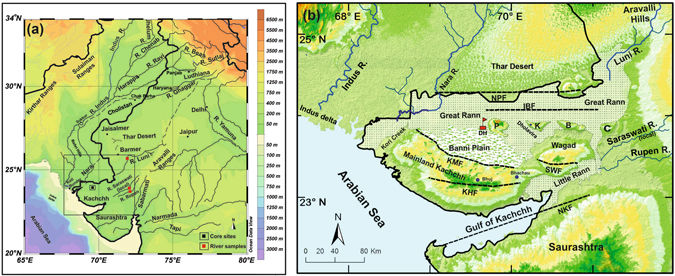
 (a) Regional drainage pattern for the western continental margin of the Indian plate. Dotted lines are the paleochannels of the Vedic Saraswati River after Ghose et al.11 and Kar and Ghose48. The box represents the area shown in b. Location of the Dhordo core site and river sediment samples analyzed are also shown. (b) Geomorphic setting of the Great Rann of Kachchh (GRK) basin with surrounding hinterland and core locations. NPF- Nagar Parkar Fault, IBF- Island Belt Fault, KMF- Kachchh mainland Fault, KHF- Katrol hill Fault, NKF- North Kathiawar Fault, SWF- South Wagad Fault, P- Pachham Island, K-Khadir Island, B- Bela Island and C- Chorar Island. Core location: DH- Dhordo core raised from central GRK basin. Maps were prepared using a licensed copy of Ocean Data49 View (https://odv.awi.de/).


Abstract
The lost Saraswati River mentioned in the ancient Indian tradition is postulated to have flown independently of the Indus River into the Arabian Sea, perhaps along courses of now defunct rivers such as Ghaggar, Hakra and Nara. The persistence of such a river during the Harappan Bronze Age and the Iron Age Vedic period is strongly debated. We drilled in the Great Rann of Kachchh (Kutch), an infilled gulf of the Arabian Sea, which must have received input from the Saraswati, if active. Nd and Sr isotopic measurements suggest that a distinct source may have been present before 10 ka. Later in Holocene, under a drying climate, sediments from the Thar Desert probably choked the signature of an independent Saraswati-like river. Alternatively, without excluding a Saraswati-like secondary source, the Indus and the Thar were the dominant sources throughout the post-glacial history of the GRK. Indus-derived sediment accelerated the infilling of GRK after ~6 ka when the Indus delta started to grow. Until its complete infilling few centuries ago, freshwater input from the Indus, and perhaps from the Ghaggar-Hakra-Nara, probably sustained a productive marine environment as well as navigability toward old coastal Harappan and historic towns in the region.

Yog  .

See also :
The Chronology of Puranic Kings and Rigvedic Rishis in Comparison with the Phases of the Sindhu–Sarasvati Civilization
Michel Danino on Sarasvati  

Wednesday, 12 July 2017

Too early to settle the Aryan migration debate?

G.Chaubey

K. Thangaraj


With genetic data currently available, it is difficult to deduce the direction of migration either into India or out of India during the Bronze Age 


On June 17, The Hindu published an article by Tony Joseph (“How genetics is settling the Aryan migration debate”) on current genetic research in India and stated that “scientists are converging” on the Aryan migration to the Subcontinent around 2000-1500 BC. This conclusion was mainly based on the results obtained from the paternally inherited markers (Y chromosome), published on March 23, 2017 in a scientific journal, BMC Evolutionary Biology, by a team of 16 co-authors including Martin P. Richards of the University of Huddersfield, which compiled and analysed Y chromosome data mainly from the targeted South Asian populations living in the U.K. and U.S. However, anyone who understands the complexity of Indian population will appreciate that Indians living outside the Subcontinent do not reflect the full diversity of India, as the majority of them are from caste populations with limited subset of regions.

Under-representation

A recent paper by Dhriti Sengupta and colleagues (‘Genome Biology and Evolution 2016’; 8:3460-3470), showed that the South Asian populations included in the “1000 Genomes Project” under-represent the genomic diversity of the Subcontinent. Tribes are one of the founding populations of India, any conclusion drawn without studying them will fail to capture the complete genetic information of the Subcontinent.

Marina Silva/Richards et al. argued that the maternal ancestry (mtDNA) of the Subcontinent is largely indigenous, whereas 17.5% of the paternal ancestry (Y chromosome) is associated with the haplogroup R1a, an indication of the arrival of Bronze Age Indo-European speakers. However, India is a nation of close to 4,700 ethnic populations, including socially stratified communities, many of which have maintained endogamy (marrying within the community) for thousands of years, and these have been hardly sampled in the Y chromosome analysis led by Silva et al., and so do not provide an accurate characterisation of the R1a frequencies in India (several tribal populations carry substantial frequency of haplogroup R1a).

Equally important to understand is that the Y chromosome phylogeny suffered genetic drift (lineage loss), and thus there is a greater chance to lose less frequent R1a branches, if one concentrates only on specific populations, keeping in mind the high level of endogamy of the Subcontinent. These are extremely important factors one should consider before making any strong conclusions related to Indian populations. The statement made by Silva et al. that 17.5% of Indians carry R1a haplogroup actually means that 17.5% of the samples analysed by them (those who live in U.K. and U.S.) carry R1a, not that 17.5% of Indians carry R1a!

Genetic affinities

Indian genetic affinity with Europeans is not new information. In a study published in Nature (2009; 461:489-494), scientists from CSIR-Centre for Cellular and Molecular Biology (CCMB), Hyderabad, and Harvard Medical School (HMS), U.S., using more than 5,00,000 autosomal genetic markers, showed that the Ancestral North Indians (ANI) share genetic affinities with Europeans, Caucasians and West Asians. However, there is a huge difference between this study and the study published by Silva et al., as the study by CSIR-CCMB and HMS included samples representing all the social and linguistic groups of India. It was evident from the same Nature paper that when the Gujarati Indians in Houston (GIH) were analysed for genetic affinities with different ethnic populations of India, it was found that the GIH have formed two clusters in Principal Component Analysis (PCA), one with Indian populations, another an independent cluster. Similarly, a recent study (‘Neurology Genetics’, 2017; 3:3, e149) by Robert D.S. Pitceathly and colleagues from University College of London and CSIR-CCMB has analysed 74 patients with neuromuscular diseases (of mitochondrial origin) living in the U.K. and found a mutation in RNASEH1 gene in three families of Indian origin. However, this mutation was absent in Indian patients with neuromuscular diseases (of mitochondrial origin). This mutation was earlier reported in Europeans, suggesting that these three families might have mixed with the local Europeans; highlighting the importance of the source of samples. Another study published in The American Journal of Human Genetics (2011; 89:731-744) by Mait Metspalu and colleagues, where CSIR-CCMB was also involved, analysed 142 samples from 30 ethnic groups and mentioned that “Modeling of the observed haplotype diversities suggests that both Indian ancestry components (ANI and ASI) are older than the purported Indo-Aryan invasion 3,500 YBP (years before present). As well as, consistent with the results of pairwise genetic distances among world regions, Indians share more ancestry signals with West than with East Eurasians”.

We agree that the major Indian R1a1 branch, i.e. L657, is not more than 5,000 years old. However, the phylogenetic structure of this branch cannot be considered as a derivative of either Europeans or Central Asians. The split with the European is around 6,000 years and thereafter the Asian branch (Z93) gave rise to the South Asian L657, which is a brother branch of lineages present in West Asia, Europe and Central Asia. Such kind of expansion, universally associated with most of the Y chromosome lineages of the world, as shown in 2015 by Monika Karmin et al., was most likely due to dramatic decline in genetic diversity in male lineages four to eight thousand years ago (Genome Research, 2015; 4:459-66). Moreover, there is evidence which is consistent with the early presence of several R1a branches in India (our unpublished data).

The Aryan invasion/migration has been an intense topic of discussion for long periods. However, one has to understand the complexity of the Indian populations and to select samples carefully for analysis. Otherwise, the findings could be biased and confusing.

With the information currently available, it is difficult to deduce the direction of haplogroup R1a migration either into India or out of India, although the genetic data certainly show that there was migration between the regions. Currently, CSIR-CCMB and Harvard Medical School are investigating a larger number of samples, which will hopefully throw more light on this debate.

Tony Joseph responds:

There is a technical point in suggesting that the South Asian populations included in the “1000 Genomes Project” under-represent the complete genomic diversity of the Subcontinent and, therefore, the 17.5 % R1a frequency the ‘BMC Evolutionary Biology’ study arrived at may not be precise.
That a sample under-represents the complete genomic diversity of India could be said of virtually any study whatsoever, including the studies that the authors of the rejoinder have done. The point about the Marina Silva/Martin P. Richards et al. study is that its conclusions about the chronology of multiple migrations into South Asia are not dependent upon the precise percentage of R1a population — they remain robust whether the R1a percentage is 12.5 % or 17.5% or 22.5 %. The precision of the percentage or the impugned under-representation would have been an issue if the study were to make detailed conclusions about, say, how the Bronze Age migrations spread across different regions in India. Since it is not doing that, under-representation ceases to be a material issue.
In an email to me on May 29, weeks before my article was published, this is what Prof. Richards said about the sample: “It’s true that some of the 1000 Genomes Project (1KGP) sequences that we analysed for genome-wide and Y-chromosome data were sampled from Indians in the U.K. and U.S., and lack tribal groups, which might well be an issue for a detailed regional study of the subcontinent (our mtDNA database was much larger). But we are simply looking at the big picture across the region (what was the role of Palaeolithic, Neolithic and Bronze Age settlement, primarily) and the signals we describe across the five 1KGP sample sets are clear and consistent and also fit well with the lower-resolution data that has been collected in the past (e.g. for R1a distributions). By putting everything together, we feel the sketch of the big picture that we propose is very well supported, even though there will certainly be a huge amount of further analysis needed to work through the regional details.”
The second argument that the rejoinder makes, as summed up in its last paragraph, is that ‘Out of India’ is a possible explanation for the genetic spread that we observe. This is helpful insofar as it accepts that the genetic spread that we observe does need an explanation. But the problem with proposing ‘Out of India’ as that explanation is the following: it is not as if the ‘Out of India’ hypothesis is new; it has been around for decades. But the rejoinder makes no reference to a single peer-reviewed genetic study that makes a serious case for ‘Out of India’.
If the hypothesis were tenable at all, shouldn’t there have been many peer-reviewed papers by now making the case and fleshing out the details?

 K. Thangaraj is with the CSIR-Centre for Cellular and Molecular Biology, Hyderabad, and G. Chaubey is with the Estonian Biocentre in Tartu, Estonia

Tony Joseph is a writer and former editor of ‘BusinessWorld’. Twitter: @tjoseph0010

Yog.

See also :
Genetics and the Aryan invasion debate 

Monday, 26 June 2017

CEREALS AS SOURCE OF FOOD IN RIGVEDA

 А.А. Семененко
 Gymnasium No 2, Voronezh, Russia
Abstract: The article deals with all descriptions of cereals as  food in Rigveda. The author demonstrates that references to cereals as food already in the most archaic cycles of the Samhita point to  sedentary and agricultural (grain growing) economy of Rigvedic  society from the very beginning of its development.  Key words: Rigveda, Indo-Aryans, cereals, food. 

We get the earliest textual evidence of Indo-Aryans (further IA) from the Rigveda Samhita (further RV) [1] composed at least several   hundred years before 2600 BC [2]. RV includes four chronological layers: 1. Family Books II– VII, the most archaic core of the collection + the IXth Mandala (or cycle)— which is most probably a result of the extraction of all the Soma hymns from the Family Books; 2. the VIIIth Mandala or Book of song-like hymns added to the emerging Samhita (cycles II– VII + IX); 3. the Ist Mandala or Introduction and 4. the most modern Xth part or the Conclusion [3]. It is crucial for the establishing of the economy type of the RV-edic IA (whether  predominantly nomadic cattle-breeding or sedentary and complex cattle-breeding and agricultural) to know the source of nutrition of the authors of the Samhita in each of the four periods of RV creating.

Already during the process of composing hymns of the most ancient Family Mandalas of RV grain was used to feed drawing animals (úpo nayasva vŕ  ̥ṣaṇā | grásetām áśvā ví mucehá śóṇā divé-dive sadŕ  ̥śīr addhi dhānā ́ḥ (III.35.3), kr  ̥tā ́ dhānā ́ áttave te háribhyām (III.35.7)). It was also consumed by people as food (dhānā ́vad juṣāṇáḥ (III.43.4), yéna tokā ́ya tánayāya dhāníyam bī  ́ jaṃ váhadhve (V.53.13), sánti dhānā ́ḥ (VI.29.4)). It could be fried (bhr  ̥ jjā ́ti dhānā ́ḥ) (IV.24.7),boiled as gruel (karambhíṇam) or baked as (a small loaf of) bread(apūpávantam) or as a cake (puroḷā ́śam) (dhānā ́vantaṃ karambhíṇam apūpávantam juṣasva (III.52.1), dhānā ́ḥ puroḷā ́śam kr  ̥ṣvehá cā ́rum (III.52.5), dhānā ́ḥ puroḷā ́śam ā ́hutam māmahasva naḥ (III.52.6), te cakr  ̥mā karambháṃ dhānā ́ḥ apūpám addhi (III.52.7), práti dhānā ́  bharata tū ́yam asmai puroḷā ́śaṃ (III.52.8)).

To some extent more modern Mandala the VIIIth contains pleas to grant grain (tuváṃ na indra āsãṃ háste dāváne dhānā ́nãṃ ná sáṃ gr  ̥ bhāya asmayúr) (VIII.70.12) and mentions corn, gruel and (a small loaf of) bread as food (dhānā ́vantaṃ karambhíṇam apūpávantam) (VIII.91.2).

Much later Mandala the Ist makes it clear that fried grain was served with melted butter (imā ́ dhānā ́ ghr  ̥tasnúvo) (I.16.2). The most modern Mandala the Xth tells us about eating corn (jakṣīyā d dhānā ́) (X.28.1) and describes the sowing of seeds and growing of grain (vápanto bī  jam iva dhāniyākŕ  ̥taḥ) (X.94.13).

References to gruel (karambhá) can be found in all chronological layers of the RV (I.187.10; III.52.1, 7; VI.56.1; VI.57.2; VIII.91.2), as well as the to the melted butter-soaked (apūpáṃ ghr  ̥távantam) (X.45.9) (loaf of) bread (apūpá) (III.52.1, 7; VIII.91.2), baked (puroḷā ́ pacatás (III.28.2), puroḷā ́śam pacatíyaṃ (III.52.2)) cake (puroḷā ́(śa))(I.162.3; III.28.1, 3, 4, 5, 6; III.41.3; III.52.3, 4, 5, 6, 8; IV.24.5; IV.32.16; VI.23.7; VII.18.6; VIII.2.11; VIII.31.2; VIII.78.1) and  barley mixed with milk and Soma (soma gávāśiro yávāśiro (I.187.9), yávāśiraṃ sómam (II.22.1), gávāśiraṃ yávāśiraṃ sutám (III.42.7), índor yávāśiraḥ (VIII.92.4)).

Notably grain as food and food made of grain appear mostly in the Family cycles of RV, much less so — in the later Mandala the VIIIth and they almost disappear in the latest (I and X) parts of the Samhita. This textual fact totally disproves the widely spread (Aryan Invasion/Immigration Theory rooted) pseudoacademic concept of RV-edic IA being nomads in the earliest period of RV composition. All  points to the conclusion that grain growing was crucial to RV-edic economy from the most archaic phase of its recorded existence.

Yog (Page 254).

See also :
ARABLE FARMING OF VEDIC INDO-ARYANS ACCORDING TO ATHARVAVEDA SHAUNAKIYA AND SAMHITAS’ DATING

Friday, 22 July 2016

Blogging on Bloggers 2 : The Vedic rituals, their innovative nature and contribution to the early knowledge by throneoftruth

 The throne of truth  is a very good website . It has many good and informative articles , this is one of them :
There are many allegations against the ancient Vedic rituals or yajnas, that they are useless and contain rather primitive contents such as animal sacrifices, obscene fertility rites etc.
Animal sacrifices, fertility rites etc were not unique to the ancient Vedic culture. We could see them in many parts of the ancient world. Before the civilizations evolved, all of humanity lived as primitive hunter gatherers who hunted animals for food and other needs. Vedic rituals dating back to the bronze age and having it’s roots in further antiquity would obviously contain elements which would be considered primitive or trangressive according to modern notions.
For example Ashavmedha or horse sacrifice involved the chief queen copulating (or at least mimicking the copulation) with the sacrificed horse and Purushamedha or human sacrifice would have also originally involved similar rite, with horse replaced by human victim. Few variations of another ritual named Gosava grants sacrificer the right to answer nature’s call anywhere he wishes and also cohabit with any women including his own mother, sister and women from his own clan, which is otherwise strictly forbidden according to Vedic laws.
These may sound bizarre, but if we look at the details of the rituals, it becomes clear that some aspects of these rituals are quite complicated to perform.
For example in Ashvamedha, the horse is sacrificed only after it is safely returned from all the neighboring kingdoms where it roamed for an year representing the king. If any of the neighboring kingdoms capture the horse, then it is a sign of war. But if the horse returned safely from the neighboring kingdoms, then it would mean that the neighboring kingdoms accepted the supremacy of the king represented by the horse. Thus the ritual could only be conducted by powerful kings. After the horse is returned safely to the hosting kingdom, it is offered to deities. It is said that along with horse, many other animals are also offered in the sacrifice. These animals are enumerated in texts like Vajasaneyi Samhita book 24 of Shukla or White Yajur Veda and Taittiriya Samhita 5.5.11-24 of Krshna or Black Yajur Veda. If we look at the animals in the list, we can see that the it includes tiny ones like flies, bees, worms etc to bigger ones like rhinoceroses, tigers, lions, crocodiles, elephants etc! Though the wild animals in the list are to be released later, all of the victims in the list must be tied to the sacrificial posts or Yupa. This huge list of animals are of course next to impossible to be used in rituals.
In similar lines, Purushamedha also follows same theme with horse replaced by human victim. It also has a list of several other victims who are to be tied in sacrificial posts. These victims are not animals as in Ashvamedha, but humans of various castes, tribes, professions, characteristics etc as numerated in Vajasaneyi Samhita book 30. This large list of victims also appears to be impossible to gather just like the Ashvamedha list, and making Purushamedha an extremely complex rite as well. Texts like Satapatha Brahmana 13.6.2.13 already treats Purushamedha as symbolic sacrifice and even certain hymns of Rig Veda like 5.2.7, 1.24.13 etc echoes the tale of Shunashepa or the boy who was chosen as victim of human sacrifice and was later released by the blessings of deities. This story could be viewed as abandonment of human sacrifice in general. But the human sacrifices continued to exist in post Vedic times, though they were extremely rare.
A ritual named Agnichayana or Athiratra also involved burying the heads of several animals and also a human head on the ground before building the fire altar, which was later replaced with replica heads.
In Gosava ritual, the sacrificer must behave like a bovine by kneeling down to eat and drink, graze on grass etc just like bovines. Though this is just one version of Gosava found in texts like Jaiminiya Brahmana 2.113, while other versions found in texts like Panchavimsha Brahmana 19.13 do not mention any transgressive acts. It is possible that the transgressive version is a modification of simpler version or vice versa. It is also said in Jaiminiya Brahmana that the king Janaka refused to perform the transgressive rite and another king Punyakesha after halting the performance of the rite declared the performance of rite as being limited to old men. The trick here was to limit the performance of this transgressive rite as much as possible, since old men won’t have much potency to perform this extremely complicated rite.
Thus these complicated ritual performances would have been extremely rare and would most likely had modifications and or symbolic performances. The ritual interpretations also varied from one Vedic text to another as mentioned above, so this indicates that the different authors modified and interpreted the rituals.
Vedic rituals are open for modifications and exceptions according to circumstances . For example when Vedic culture expanded from its heartland in north-west India into other regions, the original sacred Soma plant used in rituals was replaced with other plants due to unavailability of the original Soma in new regions where the Vedic culture expanded.
Also according to the tradition, the Vedic rituals are only to be conducted in the lands where krshna mrga or blackbucks live as stated in texts like Manu Smriti 2.23. But when Vedic culture historically expanded beyond India into new regions like south-east Asia, the Vedic rituals were also conducted in these regions. Blackbucks do not live in regions like south-east Asia and they are mostly found in India (though they are facing extinction today). Clearly, here the ritualists made exceptions to the rule which is applied in mainland India or Bharatavarsha and performed Vedic rituals in other regions like south-east Asia
In later periods, the animal sacrifices which are part of many Vedic rituals were also substituted by offerings of grain cakes or purodasha. Shatapatha Brahmana 1.2.3.6-7 narrates a story of how sacrificial essence from humans and animals finally got into grains. Shatapatha Brahmana 1.2.3.5 also states that it is as an animal sacrifice the cake is offered, and Shatapatha Brahmana 1.2.3.8 also associates different characteristics of the cake with that of different parts of animals. Further Taittiriya Brahmana 3.2.8.8 explicitly states that the rice cakes are substitutes of animal victims and Taittiriya Brahmana 3.2.8.9 also associates the cake with the sacrificer himself, hinting at the notion of self sacrifice or the sacrificer offering himself up as the animal victims represented by the cakes.
It is important to note that the method of sacrificing actual animal was also quite sophisticated.
Most of the time It involved suffocating or smothering the victim rather than butchering it as stated in Shatapatha Brahmana 3.8.1.15. Before the victim is sacrificed, the ritualists symbolically asks permission from the victim’s family to sacrifice the victim and makes the victim sacrificially pure as narrated in Shatapatha Brahmana 3.7.4.5,  Taittiriya Brahmana 3.6.6.1 etc. The language used in ritual is also quite toned down, and the victim is stated to be quieted or passed away instead of being killed. While the victim is being sacrificed, the priests would not look at the process either. The sacrificing is done by an assistant called Shamitar.
Also narrated in Shatapatha Brahmana 3.8.1.10, that the sacrifice was not considered as killing at all, since the sacrifice which is a divine act could not be equated with death. After the sacrifice, the sacrificed victim would also be symbolically cleansed and revived as said in Shatapatha Brahmana 3.8.2.4-11.
Thus we see elements of non violence in animal sacrifices, which later led to substitution of animals with cake and other vegetarian offerings. Hence we do not need to view Ahimsa or non violence and vegetarianism as a post Vedic Buddhist or Jain influence, it was a gradual development which happened within the Vedic tradition during later Vedic period. However, many ritualists would have still utilized actual animals in the rituals, while the ones who preferred non violent rituals would have used the substitute offerings.
To sum up, we see an innovation or evolution of practices in the Vedic rituals and modifications or exceptions can be made in the Vedic rituals according to circumstances, but without altering the core performance itself.
Also no matter how primitive may the Vedic rituals may sound, the rituals does have an internal meaning. For example Ashvamedha revolves the sacred horse, who is praised in Rig Veda 1.161-162. This divine horse symbolizes the fertile and ruling power or kshatra and represents the Sun. The queen would embrace the divine horse unto herself as part of the sacrifice and it is clear from texts like Shatapatha Brahmana 13.5.2.2 that this union has a cosmological background since the copulation is said to took place in heaven.
If Ashvamedha revolves about divine horse, then Purushamedha revolves around Purusha Narayana of Purusha Sukta from Rig Veda 10.90. Purusha Narayana represents the whole universe personified and the human victim used in the ritual symbolizes this Purusha.
As for the transgressive rites seen in certain versions of Gosava, these rites technically represents the notion of transcending human limitations, by living like an animal and having total freedom and liberation just like in heaven.
Thus even the so called primitive practices seems to have an internal meaning.
Also in the Vedic sense, the place where the ritual is conducted is viewed as a divine space, for example Rig Veda 1.164.5 states the ritual is the center of the whole world. Whatever done in this divine space which are guided by the Vedic Mantras would be considered as divine, including the so called transgressive acts.
Another thing is that the transgressive practices continued to exist even in post Vedic era when Tantric or Agamic (i.e temple and idol based ) mode of worship evolved. Some of the heterodox Tantric sects practicing the transgressive rites exist even today.
It is also important to note that many of the mainstream orthodox Tantric-Agamic practices are also derived from Vedic ritual practices. For example the pradakshina or parikrama, the circumambulation of temples can be compared to the practice mentioned in Shatapatha Brahmana 9.1.2.6-8 where the ritualist has to circumambulate the fire altar used in Vedic rituals.
The practice of homa or havana, the offerings made in fire altar which is done in many temples are also obviously derived from ancient Vedic fire rituals. Another practice mentioned in Shatapatha Brahmana 1.2.2.13 in which an object is purified using fire can also be compared with later ritual of Arathi.
So many of the later Tantric-Agamic practices which are still practiced widely can also be traced back to ancient Vedic practices.
Apart from this, the ancient Vedic rituals contributed to many of the early knowledge. The calculation and measurement of bricks to build the fire altars of different shapes gave rise to the ancient geometry and mathematics, the observation of stars and seasons to conduct rituals gave rise to astronomy, the speculations surrounding the sacrificial myths, goals, fruits of sacrifices etc gave rise to ancient philosophy, the strict emphasize on the use of Mantras and chanting in Vedic rituals must have given rise to the early linguistic thoughts, the acts, dialogues, dance, music etc which are part of many rituals like Ashvamedha, Mahavrata etc would have contributed to the growth of early theatrical and artistic tradition, the anatomy of sacrificial victims would have contributed to early medicinal tradition and so on.
So before calling rituals as useless or primitive, one must remember about contribution of rituals to the civilization. These ancient rituals are part of our civilization and they must be practiced to express or celebrate the ancient culture and heritage of our civilization.
Yog

Friday, 27 May 2016

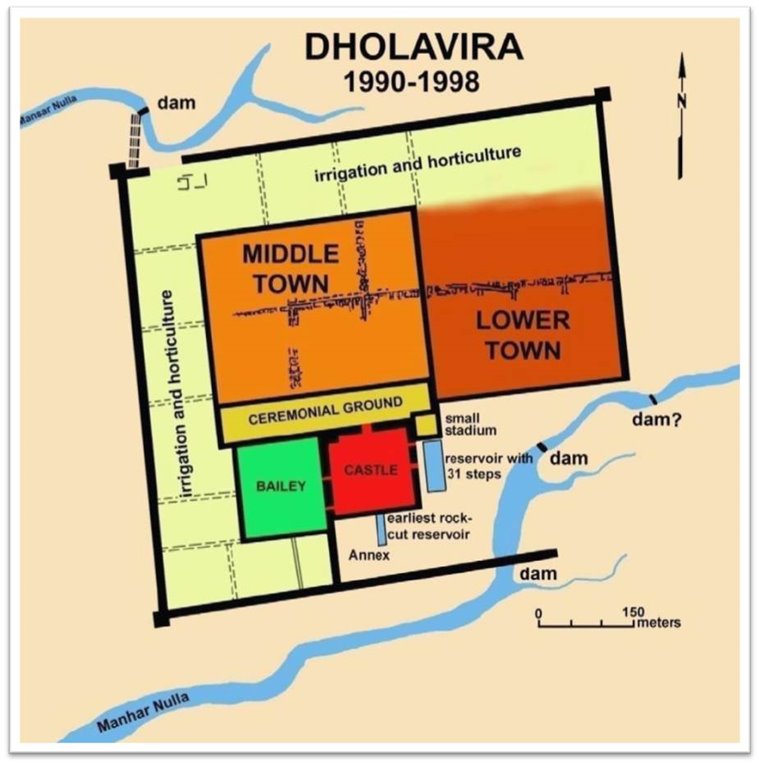
Goa: Dholavira site has first evidence of tsunami-protection wall in the world, say scientists

The discovery made by a group of Marine Archaeologist of NIO in February this year was based on a scientific probe and preliminary excavation 

Donapaula Published:May 25, 2016, 22:49
Scientific dating of ‘Fortified-walls’ around the Dholavira archaeology site in Kutch, Gujarat dates back to over 6000 years claim scientists from CSIR-National Institute of Oceanography. According to them, earlier misunderstood for reinforced forts to protect the port-town from enemy invasion, was in reality meant to protect the city from tsunami. The discovery, made by a group of Marine Archaeologist of NIO in February this year, was based on a scientific probe and preliminary excavation. Wall measuring thickness about 15-18 metres surrounded Dholavira, which the initial team of Archaeological Survey of India (ASI) led by R.S. Bisht concluded that the fortified structure was either protection wall or a reservoir, but it could be scientifically explained. 

DHOLAVIRA

“It was only recently when we tried to probe using Ground Penetrating Radar (GPR) and basic excavation that realised we discovered that it was far more broader for a enemy retaliation and did not show signs of reservoir,” Dr. Rajiv Nigam, Consultant and former Head of Marine Archaeology Unit said.

According to Nigam, study of Oceanography showed that Makkran coast that was close to Bhuj was a highly tsunami prone area and their research study indicated that the earliest recorded tsunami in the region was about 8000 years old. “So when the Dholavira was raised, the builders who had knowledge about the former catastrophe wanted to secured the walls from Tsunami and storm. The model of the wall is similar to that of 400 kilometre ‘sea-wall’ that Japan is said to have started last year, of course given the use of concrete material these days the width of the sea-wall, we have learnt is 12 metres, but the idea is the same. It means our ancestors were aware of Tsunami and succeeded in creating a defence to it,” he said. For the third-leg of the probe, the NIO team says it has already received the approval from the Archaeological Survey of India for further exploration at Dholavira. However the ambitious ‘discovery’ project has hit a dead-end due to impending financial impetus from Gujarat Council of Science and Technology. “It has been over nine-months since we sent the proposal to Gujarat Council of Science and Technology, but we have not received any update from them. It’s disappointing as we could have fastracked the discovery and probed if the ancient indigenous ‘Tsunami-wall’ was capable in deterring the catastrophe in modern times, since till date no reliable warning system has been found for the deadly ‘seismic sea wave’,” said the NIO team.


Friday, 20 May 2016

ARABLE FARMING OF VEDIC INDO-ARYANS ACCORDING TO ATHARVAVEDA SHAUNAKIYA AND SAMHITAS’ DATING

A.A. Semenenko Gymnasium No 2, Voronezh, Russia

 Researchers Conclusion :

This means that even during the latest period of AVSh composition the Sarasvati Valley abounded in dairy and grain-producing products.AVSh and not only its most ancient part must be dated not later than at least 2000 BC. RV with its more archaic language and the material of which AVSh plentifully borrows dates to at least approximately 2500 BC.

But as a couple of significant points that a friend points me :

1.  Sarasvati was still important also after 2000 BC, as attested also by Mahabharata, but its mention in AV shows a Western environment.

2. The frequent mention of barley suggests the same and an ancient agriculture.Hence the period can be the same as the tenth Mandala of RV, around the middle of 2nd mill. BC.

The article is at p.362.

Yog.

See also :
CEREALS AS SOURCE OF FOOD IN RIGVEDA

Friday, 11 March 2016

Ancient infrastructure found in Tilaurakot dig


 - MANOJ PAUDEL, KAPILVASTU

 The findings at Tilaurakot are at least 2,800 years old.
Mar 11, 2016- A team of archaeologists, including some foreign experts involved in excavation works at ancient Shakya Capital city of Tilaurakot, have claimed proofs to support the existence of historical stupas, monasteries and palaces in Kapilvastu district.

The team has unearthed an ancient city of Tilaurakot believed to be the one mentioned by Chinese travellers Fa Hian and Hiuen Tsang in their travel accounts when they visited there in the
fifth and seventh century respectively.

Kosh Prasad Acharya, a senior archaeologist, said they have found the remnants of houses, roads, walls and wells after three years of digging. “These findings match what the two Chinese travellers had mentioned in their travel accounts. We are still exploring the site,” he said.
Robin Coningham, the chief archaeologist, said the ancient infrastructure could be at least 2,800 years old.

The excavation began after a geophysical survey showed structure and an entry gate. Archaeologists suspect the structure could have been an administrative building of the time. A one-and-a-half-metre wide wall was also found 25-30cm below the ground during the excavation.

Chief of the Department of Archaeology (DoA) Ram Bahadur Kunwar said they a large ancient infrastructure in the central part of Tilaurakot was found this year. “We have found the several remains of the ancient city underneath,” he said.

The archaeologist’s team comprised mainly of 10 professors from Stirling University and Durham University of the United Kingdom, two Unesco consultants, five experts from the DoA and four from the Lumbini Development Trust. Thirteen students studying culture and archaeology at Tribhuvan University also have been involved in the excavation.

Thursday, 10 March 2016

“We drank Soma, we became immortal...”


For over a hundred years now, scientists have been discussing what plant was used to prepare Soma (Haoma), a sacred drink of the ancient Indians and Iranians, which "inspired poets and seers, made warriors fearless." The hypotheses were plenty: from ephedra, cannabis, and opium poppy to blue water lily (Nymphaea caerulea) and fly agaric (Amanita muscaria). The answer was found in a grave of a noble woman buried in an elite burial ground of the Xiongnu, the famous nomads of Central Asia


Importantly, none of the researchers denies the fact that the ancient Indians and Iranians consumed a drink with a psychoactive substance as a sacrament. However, the precise identity of the substance and its plant source, as well as its influence on human consciousness, are still being debated.
The translator and greatest authority on the Rigveda Tatyana Ya. Elizarenkova wrote: “Judging by the Rigveda hymns, Soma was not only stimulating but also a hallucinogenic drink. It is difficult to be more specific not only because none of the plants suggested as soma satisfies all the parameters and only partially answers the description of soma given in the hymns but mainly because the language and style of the Rigveda, an archaic religious tome with the typical features of ‘Indo-European poetic speech’, pose a formidable obstacle to soma identification.” Knowing perfectly well that all the possibilities of the written source had been exhausted, Elizarenkova believed that the answer could come from archaeologists, from “their findings in North-Western India, Afghanistan, and Pakistan (and not in remote Central Asia).”

Remarkably, her opinion, expressed 25 years ago, was confirmed by new findings made in Mongolia. No one could have suspected that a grave of a noble woman buried in an elite burial ground of the Xiongnu, the famous nomads of Central Asia, would answer the question asked long ago.
It happened in 2009. A team from the Institute of Archaeology and Ethnography SB RAS, which was led by Natalia Polosmak, was performing archaeological excavations in the Noin-Ula Mountains, Northern Mongolia. In tumulus 31, at a depth of 13 meters, the archaeologists discovered a wooden burial chamber. On the floor, which was covered with a thick layer of blue clay, around an old tomb ruined by ancient robbers, there were visible traces of a woollen fabric; this was all that was left of an embroidered strip, which was of great historical value even in this fragmentary state. Textiles are virtually never preserved in ancient graves, and such findings are exceptionally rare. The remains of the textile were retrieved from the grave and delivered to the Institute of Archaeology and Ethnography SB RAS. The second life of this remarkable artefact began thanks to Russian restorers.

The craftsmanship and the story unfolding on the threadbare fabric are truly amazing. Embroidered in woollen thread on the thin cloth is a procession of Zoroastrian warriors marching towards an altar; one of them, standing at the altar, is holding a mushroom in his hands.

A distinguishing feature of this embroidery is that the craftsmen did their best to depict the faces, costume, arms, plants, and insects, trying to copy everything from life. According to the mycologist I.A. Gorbunova (Candidate of Biology, senior researcher with the Inferior Plant Laboratory, Central Siberian Botanical Garden, SB RAS), the mushroom depicted on the carpet belongs to the Strophariaceae family. In some ways—the general habitus, shape of the cap, stitches along the edge of the cap reminding of the radial folding or remnants of the partial veil and dark inclusions on the stipe that can remind of a paleaceous ring, which blackens after the spores are puffed—it is similar to Psilocybe cubensis (Earle) Singer [Stropharia cubensis Earle]. Some of the mushrooms of the genus Stropharia cubensis, or Psilocybe cubensis, contain psilocybin—a unique stimulator of the nervous system. In their psychoactive properties, psilocybin mushrooms are much more befitting as vegetative equivalents of Soma, or Hoama, than fly agaric, which was identified with Soma in the Rigveda by R.G. Wasson in his well-known book. His point of view was supported by many famous scientists; the psychedelic theory proposed by T. McKenna even assigns the main role in human evolution to psilocybin-containing mushrooms.

For the first time, we can see vivid evidence, embroidered on an ancient cloth discovered by archaeological excavations, for the use of mushrooms for religious purposes, probably, to make Haoma, a “sacred drink.''

 The origin of this embroidery and characters depicted on it is associated with North-Western India and the Indo-Scythians (Sakas). How the embroidered cloth made it into a Xiongnu grave is a surprise of the so-called Silk Road, a network of trade routes crossing the whole of Eurasia. Judging by the Chinese chronicles, veils and blankets from Northern India were highly valued in the Han China.

The woollen curtain with an amazing plot was discovered after its 2,000-year-long confinement in a deep grave, which is a miracle in itself. The curtain is not only a fine example of ancient art, which was recovered thanks to the meticulous work of Russian restorers, but a unique source of information casting light on one of the obscure periods of ancient history.

Saturday, 23 January 2016

Neither Aryans migrated into north-west India, nor did Tamils migrate into South India: Michel Danino

Its not that i'm in 100 % agreement with him, but what he says mostly is correct IMO .


Neither Aryans migrated into north-west India, nor did Tamils migrate into South India: Michel Danino


By Nithin Sridhar
 The Aryan Question: Part 5
The Aryan question continues to remain highly controversial and multidimensional in nature. In order to unravel the nitty-gritty of the issue, NewsGram interviewed various scholars who have researched various aspects of the issue in depth.

In this ‘fifth installment’ of ‘The Aryan Question’, NewsGram brings an exclusive interview of Michel Danino, independent scholar, educationist, and guest professor at IIT Gandhinagar, who has authored books and papers on the issue, including The Lost River: On The Trail of the Sarasvati (Penguin India, 2010). He is also a member of the Indian Council of Historical Research.

Interview with Michel Danino

Nithin Sridhar: You have been researching the origins of River Sarasvati for many years. Can you share with us why River Sarasvati is so important for understanding ancient Indian history? What is its relevance in the debate on the Aryan issue?

Michel Danino: The Sarasvati River is important at two levels. One, as a river, since it is praised as such in the Rig-Veda, India’s oldest text; it is clear that a number of the Rig-Vedic hymns were composed in the region where the river flowed. It was part of the Vedic landscape, just like Sindhu (the Indus) or its tributaries; together they formed the Saptasidhava (the “seven rivers”). However, the Sarasvati is the only one of those rivers that disappeared, hence the search not only for the river’s location but for the causes of its disappearance. Secondly, the river was so revered that it was turned into a goddess with the additional symbolic meaning of inspiration, then speech, therefore, knowledge, therefore, education, the arts, etc. Sarasvati is thus an important symbol in Indian culture.
 If the river’s identification has become controversial, it is only since the 1980s, when it became clear from the archaeological evidence that the river dried up in its central basin around 1900 BCE. In that case, how could Aryans supposedly arriving about 400 years later describe the river as of “mighty waters”, flowing “unbroken” “from the mountain to the sea”? There is a chronological impossibility. The Rig-Veda was composed while the river was in full flow, and on the basis of current archaeological evidence, this would take us before 2600 BCE (when the river first broke up near what is today the international border in western Rajasthan). Of course, proponents of the Aryan invasion/migration theory will not accept this.

NS: You have identified the River Sarasvati mentioned in the Vedas with the dried bed of the Ghaggar-Hakra River. Can you briefly explain the evidence that has helped you to arrive at this identity? What bearing does this identification have on the whole debate surrounding Aryan migration?

M Danino: The Sarasvati’s identification with the dry bed of the Ghaggar-Hakra of Haryana, Punjab, northern Rajasthan and the Cholistan is not mine at all. It was first made by the French geographer Louis Vivien de Saint-Martin way back in 1855! It was soon endorsed by almost all European Indologists (such as HH Wilson, F Max Müller, Marc Aurel Stein, Louis Renou), geographers and geologists (such as RD Oldham), and later archaeologists (Stuart Piggott, Mortimer Wheeler, and Aurel Stein again, not to speak of recent ones like RAllchin or GL Possehl and numerous Indian archaeologists). Today’s critics of this identification conceal this longstanding consensus as they dishonestly want to create an impression that the identification is a recent “Hindutva” theory. It is no such thing.

The reasons for the identification are very simple: 1) In its tenth and final mandala, the Rig-Veda has a hymn “in praise of rivers” (the famous Nadistuti Sukta) which lists Sarasvati between the Yamuna and the Sutlej; 2) later literature, from the Brahmanas to the Mahabharata not only confirms the river’s location but records its gradual retreat; 3) there is in Haryana a small “Sarsuti”, a tributary to the Ghaggar, and also an old tradition that the Sarasvati’s source is nearby in the Shivalik Hills. These are precisely the points that the nineteenth-century scholars used to reach their conclusion.

NS: Some Aryan migration proponents argue that the Rigveda refers to two different Sarasvati rivers. They identify the one referred to as “Naditama” in older portions of Rigveda with Helmand in Afghanistan, and the Sarasvati mentioned in Nadisukta and other later portions of Rigveda with the Ghaggar. Another argument forwarded to support Helmand hypothesis is that ‘Samudra’ refers to ‘lake’ and not ‘ocean’. What is your view on this?

M Danino: The linguistic argument that the Helmand had an ancient Avestan name, “Harahvaiti”, which is cognate with “Sarasvati”, proves nothing, since we might just as well turn it around and propose that this is evidence of a migration out of India. Or, if we get a little less obsessed with migrations, we could see it as a sign of cultural interaction. In any case, there is nothing to show that the Rig-Veda refers to one river in its older hymns and to another in the Nadistuti Sukta — this is an artificial device imposed on the text to get away from the chronological implications I referred to above. The absurdity becomes clear if you consider that the Ghaggar had long dried up by the time (1500 to 1200 BCE) the Aryans are supposed to have reached it: why should they transfer the name “Sarasvati”, a river they extolled, to what had by then become a puny seasonal stream?

As regards “Samudra”, the word can indeed be used in principle for any sizeable water body, but in many passages, it clearly refers to the ocean. Thus the legend of Bhujyu, rescued from a storm in the “billowy Samudra” by the Ashvins. There are many mentions of seven rivers meeting the Samudra, of waves, ships, storms, etc. In fact, HH Wilson plainly stated in 1866 that the Rig-Veda’s hymns were “familiar with the ocean and its phenomena”; Max Müller agreed, writing in 1882 that “the word Samudra shows in by far the larger number of passages the clear meaning of ocean.” It is silly to deny this simply to portray Aryans as freshly arrived from landlocked Afghanistan!
Ghaggar river flowing in Haryana. Photo: www.niticentral.com
Ghaggar river flowing in Haryana.

NS: Can you briefly explain the salient features of the Indus-Sarasvati civilization? Also, share about the time period, urbanization, and the eventual decline of it.

M Danino: It was the first urban civilization of the Indian subcontinent. After a few millennia of slow and gradual developments, by 2600 BCE cities came up over much of the Northwest. They did not boast pyramids, imposing temples or colossal statues, but displayed planning to an unprecedented degree in the Bronze Age; Mohenjo-daro also had a remarkable drainage system. Harappans were primarily manufacturers, craftsmen and traders (of course agriculturists too). The cities appear wealthy enough, though not ostentatiously so. It is now clear that by 1900 BCE (a little earlier or later depending on the region) the whole civilization disintegrated and cities were either abandoned or reverted to semi-rural settlements. The current consensus is that climatic and environmental changes (including the drying up of the Sarasvati at about the same time) played a major role in this.

NS: Contrary to the assertions of AMT proponents that Indus civilization was a non-Vedic, non-Aryan civilization, you have argued that there is continuity between Indus civilization and the later Vedic civilization in the Gangetic plains. Can you shed more light on this? What similarities can be observed between the two civilizations?

M Danino: I never speak of “Vedic civilization”, only of “Vedic culture”, and there is no proof that it is “later” — that is no more than an opinion, albeit the dominant one. What I have done is to add my bit to the body of evidence of numerous bridges and commonalities between Harappan and Vedic cultures, many of which have been pointed out for decades, and to the enormous Harappan legacy to the Gangetic civilization of the first millennium BCE. For instance, fire altars are unmistakable at sites like Kalibangan, Lothal and Banawali; Harappan figurines point to some practice of yoga and meditation; Harappan units of weight and length, as well as auspicious proportions, survive, as do several important symbols, concepts of iconography and craft techniques. And much more. The so-called break between the two cultures is, again, an artificial device imposed by the Aryan scenario.

NS: The absence of horses and chariots in Harappan sites has been pointed out as being definite evidence of the Indus civilization being Non-Aryan, Non-Vedic civilization. You have extensively written refuting it. Can you summarize your observations?

M Danino: This is a poorly constructed argument as it misrepresents the evidence at every step. Very briefly, it is incorrect to state that the horse was unknown to Harappans: horse bones or teeth have been identified at over a dozen sites (even at a couple of pre-Harappan sites) by the best archaeozoologists so that even conservative archaeologists like Piggott or Wheeler accepted the animal’s presence. The argument also incorrectly implies that with the supposed coming of the Aryans, evidence of the horse should become widespread — quite the contrary, relics of the animal remain few and far between. The horse is also rarely depicted in art until the Mauryan Empire. Finally, 25 years ago, the respected British anthropologist Edmund Leach protested at the misreading of the Rig-Veda that would have a Vedic society full of horses; he pointed out that the animal was, on the contrary, used as a “prestige animal” that would rather point to its rarity. In fact, a century ago, Sri Aurobindo had warned that just as ‘go’ in the Rig-Veda means both a cow and light, ‘ashva’ refers both to the horse and to speed or energy, and many passages were misread by taking the word at its literal meaning. Of course, our Aryan proponents have no use for such nuanced points and continue to bludgeon their “no horse” argument.

NS: The presence of speakers of Brahui (which belongs to Dravidian family of languages) in Balochistan has been used to point out that Dravidian speakers were in North-West India and after the influx of Aryan speakers, they migrated into South India. What is your view on this?

M Danino: One more methodologically flawed argument. Way back in the 1920s, the French linguist Jules Bloch demonstrated that Brahui reached Baluchistan recently, perhaps at the time of the Islamic invasions and probably from central India. This thesis was more recently endorsed by the noted linguist Murray Emeneau, and still more recently by H.H. Hock. Finally, the linguist and mathematician Josef Elfenbein confirmed it using a different approach. It is completely illegitimate to see the language as a “relic” from the Harappan times; the argument, still misused today to establish that the authors of the Indus Valley civilization were “Dravidians,” has no linguistic validity.

NS: Do we find any archaeological pieces of evidence in South India or any literary pieces of evidence in old Tamil Sangam literature that speak about a migration of Dravidians into South India or the interaction between Aryan and Dravidian speakers?

M Danino: There are no references to a northern origin of Tamil speakers in the Sangam literature and no animosity against northern Indians. On the other hand, its earliest layers are already quite familiar with the Vedas and important themes of Hindu mythology, for example, Ganga or the Himalayas are objects of reverence. As regards the archaeological record, just as it has failed in the North to document the supposed arrival of the so-called Aryans, it is completely silent in the South about a migration from the north. Archaeology has no need and no use for the invisible Aryans, which is why most archaeologists have quietly shown them the door.
NS: The invasion/migration theory was first hypothesized to explain the commonalities between Sanskrit and certain European languages. In the case of non-invasion, non-migration scenario, how would these commonalities be explained?

M Danino: There are quite a few alternative scenarios, which surprisingly have received very little attention. “Surprisingly” because the failure to trace Aryans — let us now call them Indo-European speakers, a better term anyway — in north India is repeated in central Asia and also Europe; bioanthropology (the study of skeletal remains) and most recent genetic studies have also failed to discern the arrival of a new people in the 2nd millennium BCE.

Alternative linguistic models include (1) models of language propagation that do not require population movement but only contact (such models have been in place since the 19th century); (2) models of a “broad homeland” for Indo-European languages, in which they evolved by convergence rather than divergence from a proto-language (which, in this case, need not have existed at all); (3) models that do accept such a proto-language but put it at a much more remote period, 7000 BCE or beyond, which allows time for more complex interactions; (4) Out-of-India models, in which the proto-language originated from the subcontinent. Let us also note that a few professional linguists go further: “The very idea of an ‘Indo-European’ language family on which Indology is based is scientifically indefensible. IE linguists ignore vast amounts of data that do not fit with their classification. Sanskrit shares some features with Greek and Latin but it also shares equally important features with Afro-Asiatic. Indology as a discipline can be useful if it frees itself from the yoke of IEL [Indo-European linguistics]” (A. & R. McMahon, 2005). Clearly we are far from a linguistic consensus.

NS: Can you briefly summarize the protohistory of India, in the light of currently available archaeological, literary, linguistic, and genetic evidence?

M Danino: We should honestly acknowledge that current data remains insufficient for a complete picture; for instance, only about 10% of the Mature (or urban) Harappan settlements have been excavated. However, there is no reason to assume a discontinuity between the Harappan or Indus civilization and the later Gangetic civilization, as the Aryan model demands: cultural and biological continuities between the two are now numerous and well-documented. The archaeological continuity goes back to 7000 BCE or so at Mehrgarh (Baluchistan) and possibly Bhirrana in Haryana (though much more work needs to be done there).

The literary evidence is more difficult. Since the Rig-Veda does not mention rice, cotton, bricks, cities or ruins, and refers to the Sarasvati as flowing “from the mountain to the sea”, some scholars have been tempted to place its most ancient hymns at a period prior to the Mature Harappan phase (2600-1900 BCE), that is, about 3000 BCE or earlier. That is also what scholars like Tilak and Jacobi had suggested (going back to 4000 BCE, in fact) on astronomical grounds, and we have more such astronomical arguments by now. Of course, the mainstream view remains that the Rig-Veda cannot be older than 1500 BCE, but it has no convincing replies to the many paradoxes that this late date raises.
Yog.