Search This Blog

Showing posts with label Ancient DNA. Show all posts

Saturday, 31 March 2018

Harvard's ''Genomic Formation of South and Central Asia ''

So here we have an aDNA paper from Narasimhan et al , published at bioRxiv today. It is a big paper, containing more than 350 ancient samples, from important ancient sites of Central Asia ,Iran and also S Asia. The apparent impression from the first read is that, they have found ''evidence'' of migration from Steppe to S Asia. They don't have Mature Harappan samples, which is a shame.The S Asian samples are from Swat/Pakistan dating from only around 1200 bce to historical period. In those samples they have found no R1a except a singleton R1a from Saidu_Sharif_IA I6891 (500-300 BCE) .The archaeological  studies from the past have shown that Swat culture had largely female centered characteristics rather than the expected opposite , see here for example.The importance of feminine  is also reflected in modern culture of Kalash also, like freedom of women, and goddess cult, see here.
Interestingly, they have ruled out BMAC as potential source population of S Asians, this goes against the traditional AIT model . I am suspecting for example, the West Siberian HG ancestry they have discovered is actually Central Asian HG component ,which included N India.In the BMAC main cluster they measure this ancestry at 13%, but in Sarazm EN , it had around 25% presence(just as in the samples from Pakistan!, suggesting dilution by West Asian migration rather than what they imply.) , in their qpAdm based analysis(p.22 main paper) we only see the green Siberian HG ancestry appearing in ancient S Asians, while EHG related one is absent. From main paper p.9:
Third, between 3100-2200 BCE we observe an outlier at the BMAC site of Gonur, as well as two outliers from the eastern Iranian site of Shahr-i-Sokhta, all with an ancestry profile similar to 41 ancient individuals from northern Pakistan who lived approximately a millennium later in the isolated Swat region of the northern Indus Valley (1200-800 BCE). These individuals had between 14-42% of their ancestry related to the AASI and the rest related to early Iranian agriculturalists and West_Siberian_HG.
There cannot be any doubt that this West_Siberian_HG-related ancestry was in  N India since at least 3000 BCE, but probably much earlier. Also finding ancestry related to ''S Asian HG''s may imply, that it was  also well present in N India prior to 2000 bce , but was it uniformly present? only aDNA from India will clarify.Their argument is mainly based on the samples like  Gonur2_BA migrant being representative of the whole SSVC population!. But in near future, if we get samples from SSVC proper and they show  strong relation to the SPGT samples, the whole argument falls.They also didn't find the S Asia specific R1a-L657, in any of their ancient samples ...

The Genomic Formation of South and Central Asia
            Vagheesh  M Narasimhan et al.
doi: https://doi.org/10.1101/292581
Abstract
The genetic formation of Central and South Asian populations has been unclear because of an absence of ancient DNA. To address this gap, we generated genome-wide data from 362 ancient individuals, including the first from eastern Iran, Turan (Uzbekistan, Turkmenistan, and Tajikistan), Bronze Age Kazakhstan, and South Asia. Our data reveal a complex set of genetic sources that ultimately combined to form the ancestry of South Asians today. We document a southward spread of genetic ancestry from the Eurasian Steppe, correlating with the archaeologically known expansion of pastoralist sites from the Steppe to Turan in the Middle Bronze Age (2300-1500 BCE). These Steppe communities mixed genetically with peoples of the Bactria Margiana Archaeological Complex (BMAC) whom they encountered in Turan (primarily descendants of earlier agriculturalists of Iran), but there is no evidence that the main BMAC population contributed genetically to later South Asians. Instead, Steppe communities integrated farther south throughout the 2nd millennium BCE, and we show that they mixed with a more southern population that we document at multiple sites as outlier individuals exhibiting a distinctive mixture of ancestry related to Iranian agriculturalists and South Asian hunter-gathers. We call this group Indus Periphery because they were found at sites in cultural contact with the Indus Valley Civilization (IVC) and along its northern fringe, and also because they were genetically similar to post-IVC groups in the Swat Valley of Pakistan. By co-analyzing ancient DNA and genomic data from diverse present-day South Asians, we show that Indus Periphery-related people are the single most important source of ancestry in South Asia — consistent with the idea that the Indus Periphery individuals are providing us with the first direct look at the ancestry of peoples of the IVC — and we develop a model for the formation of present-day South Asians in terms of the temporally and geographically proximate sources of Indus Periphery-related, Steppe, and local South Asian hunter-gatherer-related ancestry. Our results show how ancestry from the Steppe genetically linked Europe and South Asia in the Bronze Age, and identifies the populations that almost certainly were responsible for spreading Indo-European languages across much of Eurasia.

Yog

Tuesday, 23 May 2017

Biomolecular Prehistory of South Asia Project

Biomolecular Prehistory of South Asia Project

This project applies a novel, multi-proxy approach, incorporating stable isotope analysis, dental calculus, proteomics and aDNA, to elucidate changes in diet, demography, and ecology across major cultural transitions in South Asia.
Yog. 
There is also the upcoming presentation on some aDNA data : 
Title: E-P18.02 - Reconstructing the human population history of the Indian subcontinent using ancient population genomics.
Keywords: Ancient DNA; population Genetics
Authors: N. Rai1, K. Thangaraj1, V. Shinde2; 
1Centre for Cellular and Molecular Biology, Hyderabad, India, 2 Deccan College Post-Graduate and Research Institute, Pune, India.
Abstract: The more than 1.3 billion people who live in Indian subcontinent correspond to several large ethnic groups who are highly diverse and complex. Importantly, India’s genetic past remains a subject a great debate due to numerous hypotheses surrounding population origins and migrations within and from outside India. In order to reconstruct and explain the patterns of genetic diversity evident in modern humans, an understanding of both past and present population dynamics is crucial. Several studies have shown that genetic data from ancient individuals are indispensable when reconstructing past population histories. We for the first time use the ancient genomics approach in South Asia to reconstruct the complex human population history of Indian Sub continent. We are exploring the recent technological advancement to directly test these hypotheses using ancient and modern human DNA in India. We have collected several ancient skeletal remains from different time scale of human civilization ranging from early Mesolithic, Neolithic, Harappan (Indus Valley civilization) and Megalithic culture. With the whole/partial genome NGS data, we are reconstructing the prehistoric peopling and migration of modern human in the Indian subcontinent. We are also testing the pervasive founder events and gradient of recessive genes accumulation by comparing the ancient genome with the modern human population of India.
Presentation Time: Sunday, May 28, 2017, 9:00 AM - 5:45 PM 

See here and also here
This is something that we are all waiting for a long time . We can be confident, that the data will be very important regarding the Aryan controversy . Although without the clear cut decipherment of the SSVC/IVC script , a decisive knowledge is still a bit far . 

Tuesday, 24 May 2016

New Presentation: Harappan Burial Sites of India: Recent Research Trends

The concluding remarks in that picture , are interesting .  They speak of Neolithic genetic exchange,  from Iranian plateau via trade . That almost certainly is of 4500-3800 BC period , as recorded in archaeology. The second which they link with trade, in the 1st millennium BC, also has archaeological record. But I think rather trade , migration is the way to see it . I am confident , that the first genetic exchange/migration is related to the arrival of IE's.

Harappan civilization flourished mainly in northwestern province of Indian subcontinent, roughly between 4000 to 1500 BCE. There are about more than fifty burial sites of the Harappa Civilization discovered so far. Lothal, Kalibangan, Rupar, Rakhigarhi, Farmana, Sanauli etc are major sites yielding the remains of Harappan burial.
Until the early 1980’s,the study of human skeletal were primarily focused to answer specific questions pertaining to establishing the ethnic or racial identity of the concerned population and was used primarily to complement archaeological hypotheses of cultural migration or diffusion. Recently, however, efforts are made to study diet, health and composition of Harappan population. Some of these issues are tackled by using Stable Isotope and DNA analyses. The aim of present paper is give overview of so far research done on the Harappan burials and to focus on latest scientific research carried out on Harappan burial studies.

Yog.

UPDATE : A new related post has appeared, It seems to be yet another modification of abstract , see here  :

[New Presentation] 24th Federation Meeting of Korean Basic Medical Scientists 2016

     Harappan Burial Sites in India: A Review Based On the Latest  Anthropological Research Approaches 


          Astha Dibyopama1, Vasant Shinde1, Dong Hoon Shin2 and Nilesh P. Jadhav1
1Department of Archaeology, Deccan College Post Graduate and Research Institute, India
2Department of Anatomy, Institute of Forensic Science, Seoul National University, Korea
Burial is one of the important evidence to know about our ancestors. Harappan civilization flourished mainly in northwestern province of Indian subcontinent, roughly from between 4000 to 1500 BCE. There are about more than fifty burial sites of the Harappa Civilization discovered so far most of them belonging to a period between 2500-1500 BCE. Lothal, Kalibangan, Rupar, Rakhigarhi, Farmana, Tarkhanwala Dera, Sanauli, Bedwa, Puthi Seman, Bhorgarh, etc. are major sites yielding the remains of Harappan burial. Until the early 1980’s, the study of human skeletal were primarily focused to answer specific questions pertaining to establishing the ethnic or racial identity of the concerned population and was used primarily to complement archaeological hypotheses of cultural migration or diffusion. Recently, however, efforts are shifted to anthropological studies on diet, health and composition of Harappan population. Some of these issues are undertaken by high-end using Stable Isotope and DNA analyses. We intend in this presentation is to focus how these scientific methods which are freshly applied in Harappan burial research are fairly valuable for reconstruction of a variety of aspects of Harappan civilization.
Keywords: Harappan Civilization, Burial sites, Human skeletal remains, Stable Isotope, DNA study

See also :

Rakhigarhi more important than Mohenjo Daro: Data

Upcoming Paper on Sindhu-Sarasvati Valley Civilization

Rakhigarhi: Indian town could unlock mystery of Indus civilisation


Monday, 2 May 2016

Rakhigarhi more important than Mohenjo Daro: Data

CAPITAL OF CIVILISATION


Rakhigarhi more important than Mohenjo Daro: Data
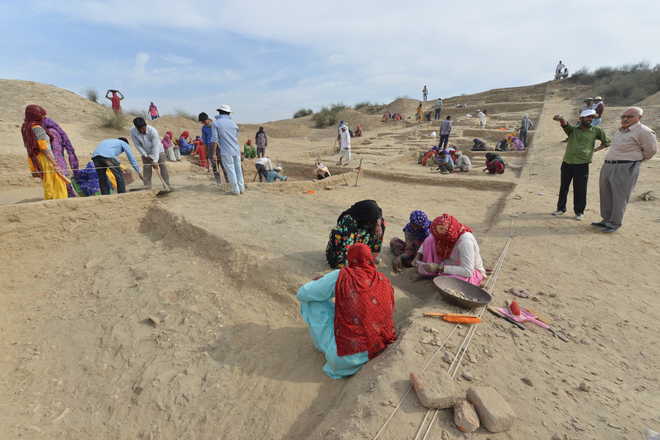
Workers carry out excavation work at Rakhigarhi village in Hisar district. Photo: Sunil Phogat 

Deepender Deswal
Tribune News Service
Rakhigarhi (Hisar), May 2
Archaeological findings and scientific data have indicated that Rakhigarhi had been the more important centre of the Indus Valley Civilisation than the townships of Harappa and Mohenjo Daro located in Pakistan.

The team of archaeologists revealed that the excavation at this site is all set to change the view that Mohenjo Daro was the capital city of the Indus Valley Civilisation. “Instead, the scientific data collected on the basis excavations here have strongly pointed that Rakhigarhi, a metropolis, was perhaps the capital of its times about 5,000 years ago,” said Prof Vasant Shinde, in charge of the excavation and Vice Chancellor of Deccan College, Pune. Deccan College and the Haryana archaeological department have been jointly carrying out the excavation at the site from last three years.

To prove his point, Prof Shinde said this site was spread in over 550 hectares, which is about double than that of the Mohenjo Daro site, which was considered the biggest site till now.
“We have collected evidences of massive manufacturing and trade activities in this town, which revealed the economic organisation and the foreign links of people here. They had trade links with people in Rajasthan, Gujarat, Baluchistan and even Afghanistan. The city flourished during the early Harappan era dating back to around 3,300 BC and existed till 2000 BC,” he said.

Moreover, the DNA samples collected from the skeletons at the cemetery here are set to crack a major mystery surrounding their lives, character, diseases and race of the people who lived here 5,000 years ago.

Scientists have, for the first time ever, succeeded in extracting DNA from the skeletons of the Indus Valley Civilisation. More skeletons have been found during the ongoing excavation season from mound no.2 for further analysis. Three different institutes of world repute are conducting the DNA analysis for a foolproof study, so that there is no scope of any contradiction,” Prof Shinde said.

He said this was the best and most unexplored site related to the Indus Valley Civilisation so far. “So much material is available here that it would take 100 years to complete the study on uninhabited mounds on the outskirts of the village.

Health Minister Anil Vij, who visited the site on Saturday, said since Rakhigarhi was turning out to be the biggest and most crucial Harappan site in the world, the state government had decided to set up a museum, research centre and a hostel for the researchers in the village.

Yog.

See also :
Rakhigarhi: Indian town could unlock mystery of Indus civilisation
Upcoming Paper on Sindhu-Sarasvati Valley Civilization


Tuesday, 22 March 2016

Upcoming Paper on Sindhu-Sarasvati Valley Civilization

The papers abstract seems fantastic. Unfortunately it is not available yet.

 Harappan Burial Sites in India: Recent Research Trends


Astha Dibyopama1, Vasant Shinde1, Dong Hoon Shin2, Chang Seok Oh2 and Nilesh P. Jadhav1
1Department of Archaeology, Deccan College Post Graduate and Research Institute, India
2Institute of Forensic Science, Seoul National University, Korea


Harappan civilization flourished mainly in northwestern province of Indian subcontinent, roughly from between 4000 to 1500 BCE. There are about more than fifty burial sites of the Harappa Civilization discovered so far most of them belonging to a period between 2500-1500 BCE. Lothal, Kalibangan, Rupar, Rakhigarhi, Farmana, Tarkhanwala Dera, Sanauli, Bedwa, Puthi Seman, Bhorgarh, etc. are major sites yielding the remains of Harappan burial. Until the early 1980’s, the study of human skeletal were primarily focused to answer specific questions pertaining to establishing the ethnic or racial identity of the concerned population and was used primarily to complement archaeological hypotheses of cultural migration or diffusion. Recently, however, efforts are made to study diet, health and composition of Harappan population. Some of these issues are tackled by using Stable Isotope and DNA analyses. The aim of present paper is to focus how these scientific methods that are recently applied to Harappan burial studies are quite useful for reconstruction of various aspects of Harappan civilization.

UPDATE : 24.03.2016
The papers abstract is modified :

Harappan civilization flourished mainly in northwestern province of Indian subcontinent, roughly between 4000 to 1500 BCE. There are about more than fifty burial sites of the Harappa Civilization discovered so far. Of them, Lothal, Kalibangan, Rupar, Rakhigarhi, Farmana, Tarkhanwala Dera, Sanauli, Bedwa, Puthi Seman, Bhorgarh etc. are major sites yielding the remains of Harappan burial. Until the early 1980’s, the study of human skeletons was primarily focused to answer specific questions pertaining to establishing the ethnic or racial identity of the concerned population and was used primarily to complement archaeological hypotheses of cultural migration or diffusion. Recently, however, more efforts are also made to study diet, health and genetics of Harappan population. The aim of present paper is to show how these scientific methods that are recently applied to Harappan burial studies are useful for the complete reconstruction of Harappan civilization and its people.

UPDATE II : 26.03.2016
Another modification :

Harappan civilization flourished mainly in northwestern province of Indian subcontinent, roughly between 4000 to 1500 BCE. There are about more than fifty burial sites of the Harappa Civilization discovered so far. Among them, Lothal, Kalibangan, Rupar, Rakhigarhi, Farmana etc. are major sites yielding the remains of Harappan burial. Until the early 1980’s, the study of human skeletons was primarily focused to answer specific questions pertaining to establishing the ethnic or racial identity of the concerned population. Recently, however, more efforts are made to study the diet, health and DNA of Harappan population, assuming a new aspect of research trends on this. The aim of present paper is to show how the scientific methods applied to Harappan burials are used for the complete reconstruction of Harappan civilization and its people.Queries about this poster might be sent to A.Dibyopama(astha2sep@gmail.com), the major author of this study.

Yog.

See also :
Rakhigarhi: Indian town could unlock mystery of Indus civilisation
Rakhigarhi more important than Mohenjo Daro: Data

Wednesday, 30 December 2015

Rakhigarhi: Indian town could unlock mystery of Indus civilisation

Some news on the aDNA which will probably decide the Indo-European History of India.

Rakhigarhi: Indian town could unlock mystery of Indus civilisation

Archaeologists hope DNA from four skeletons will shed light on bronze age settlement as locals see chance to develop more than just site’s ancient heritage

Jason Burke  in Rakhigarhi
Wednesday 30 December 2015 11.29 GMT


Visitors at the archeological site of Mohenjo-daro in Sindh province, Pakistan
 Visitors at the archeological site of Mohenjo-daro in Sindh province, Pakistan, one of the main centres of the Indus civilisation. Photograph: Waqar Hussain/EPA

 Wazir Chand is explaining life 4,000 years ago. He points to the rocky mounds looming over a huddle of brick houses, a herd of black buffalo and a few stunted trees. The rising sun burns off a chill mist over the north-west Indian plains.

A low rise was a fortification, Chand says, and a darker patch of red earth hides the site of an altar. Nimbly stepping around piles of buffalo dung, he points to a slight depression. This, apparently, was a pit that may have been a reservoir.

To the casual onlooker, Rakhigarhi is unimpressive. Yet the rubbish-strewn mounds and fields around and under this Indian village are set to deliver the answer to one of the deepest secrets of ancient times.

Rakhigarhi is a key site in the Indus Valley civilisation, which ruled a more than 1m sq km swath of the Asian subcontinent during the bronze age and was as advanced and powerful as its better known contemporary counterparts in Egypt and Mesopotamia.

Archaeologists have learned much about the civilisation since it was discovered along the Indus river in present day Pakistan about a century ago. Excavations have since uncovered huge carefully designed cities with massive grain stores, metal workshops, public baths, dockyards and household plumbing, as well as stunning distinctive seals. But many perplexing questions remain unanswered.

One has stood out: who exactly were the people of the Indus civilisation? A response may come within weeks.

“Our research will most definitely provide an answer. This will be a major breakthrough. I am very excited,” said Vasant Shinde, an Indian archaeologist leading current excavations at Rakhigarhi, which was discovered in 1965.

Shinde’s conclusions will be published in the new year. They are based on DNA sequences derived from four skeletons – of two men, a woman and a child – excavated eight months ago and checked against DNA data from tens of thousands of people from all across the subcontinent, central Asia and Iran.
“The DNA is likely to be incredibly interesting and it has the potential to address all sorts of challenging questions about the population history of the people of the Indus civilisation,” said Dr Cameron Petrie, an expert in south Asian and Iranian archaeology at the University of Cambridge.

The origins of the people of the Indus Valley civilisation has prompted a long-running argument that has lasted for more than five decades.

Some scholars have suggested that they were originally migrants from upland plateaux to the west. Others have maintained the civilisation was made up of indigenous local groups, while some have said it was a mixture of both, and part of a network of different communities in the region. Experts have also debated whether the civilisation succumbed to a traumatic invasion by so-called “Aryans” whose chariots they were unable to resist, or in fact peaceably assimilated a series of waves of migration over many decades or centuries.

The new data will provide definitive answers, at least for the population of Rakhigarhi.

“There is already evidence of intermarriage and mixing through trade and so forth for a long time and the DNA will tell us for sure,” Shinde said.

The conclusions from the new research on the skeletal DNA sample – though focused on the bronze age – are likely to be controversial in a region riven by religious, ethnic and nationalist tensions.

Hostile neighbours India and Pakistan have fought three wars since winning their independence from the British in 1947, and have long squabbled over the true centre of the Indus civilisation, which straddles the border between the countries.

Shinde said Rakhigarhi was a bigger city than either Mohenjo-daro or Harrapa, two sites in Pakistan previously considered the centre of the Indus civilisation.

Some in India will also be keen to claim any new research supports their belief that the Rig Veda, an ancient text sacred to Hindus compiled shortly after the demise of the Indus Valley civilisation, is reliable as an historical record.

The question of links between today’s inhabitants of the area and those who lived, farmed, and died here millennia ago has also prompted fierce argument.

There are other mysteries too. The Indus Valley civilisation flourished for three thousand years before disappearing suddenly around 1500 BC. Theories range from the drying up of local rivers to an epidemic. Recently, research has focused on climate change undermining the irrigation-based agriculture on which an advanced urban society was ultimately dependent.

Soil samples around the skeletons from which samples were sent for DNA analysis have also been despatched. Traces of parasites may tell archaeologists what the people of the Indus Valley civilisation ate. Three-dimensional modelling technology will also allow a reconstruction of the physical appearance of the dead.

“For the first time we will see the face of these people,” Shinde said.

In Rakhigarhi village, there are mixed emotions about the forthcoming revelations about the site.

Chand, the self-appointed guide and amateur expert, hopes the local government will finally fulfil longstanding promises to build a museum, an auditorium and hotel for tourists there.

“This is a neglected site and now that will change. This place should be as popular as the Taj Mahal. There should be hundreds, thousands of visitors coming,” Chand told the Guardian.

A brief glance at the rubbish strewn middens which the mounds of the ancient city have become, indicates the work to be done before Rakhigarhi becomes a major attraction. The inhabitants of today’s Rakhigarhi lack many of the facilities enjoyed by those who lived there in the bronze age. Raj Bhi Malik, the village head, sees an opportunity to develop more than the site’s ancient heritage.

“We want a museum and all that certainly … but also clean drinking water, proper sanitation, an animal hospital, a clinic too,” Malik said.
 Yog.
UPDATE :
Here is a recent post from a well known genome blogger. This only again reflect, the importance of the study, regarding the Indo-European question.

Update II : Here another post on the monumental study.
 .

Tuesday, 26 May 2015

Ancient Iron Works From South India

I came to know about the discovery from this website ,it also reminds me the case of  Hallur Horse.

Rare discovery pushes back Iron Age in India

Siddharth Tadepalli 

HYDERABAD: Iron Age may have come into existence in Telangana much before the rest of the world. At least that's the conclusion reached by archaeologists excavating the University of Hyderabad campus who found iron artefacts dating back to roughly 2,200 BCE.

The team of archaeologists, led by professor KP Rao, has found several artefacts, including small knives and blades besides earthen pots. "The implements that were found were tested at the National Geophysical Research Institute (NGRI) using a method called Optically Simulated Luminescence (OSL). The metal objects were dated to anywhere between 1800 BC and 2,400 BCE. So we are assuming they were made during 2200 BC," Prof KP Rao told TOI.

This, he said, predates the existing understanding about the advent of the Iron Age in the country. Worldwide, experts have put the dawn of the age around 1200 BC, marking the time when humans started exploiting metals to make basic tools.

"In India, it was understood that the Iron Age came into being around 1,800 BC in the Lahuradeva site in Uttar Pradesh. But this latest development shows that the Iron Age started much before that, at least in our country," Rao said.

"It only goes to show that our ancestors had a rudimentary yet good knowledge about wielding weapons made of metals. We had estimated that the only metal that was moulded was copper, but due to its scarce nature it was not a feasible option. The idea of using abundant iron ore for tools and weapons is a landmark achievement," he added.

The idea of using iron has only come to lead to more and more developments. "It is because of their advancements did we reach the space-age," he said.

Currently, archaeologists have excavated 25 burial sites in the UOH area and the samples have been subjected to DNA analysis.
Yog.
Related News-

Sunday, 12 January 2014

From Dna sequencing down to Parasite Eggs : The downfall of Farmana aDNA

There was the indication that they will Fail to yield the aDNA which i declared as the most important at least for the Indo-European study and for the history of the Aryans but now it appears that they may still come up with something useful, it is not the end...

Scientists to study parasite eggs in Harappan graves